
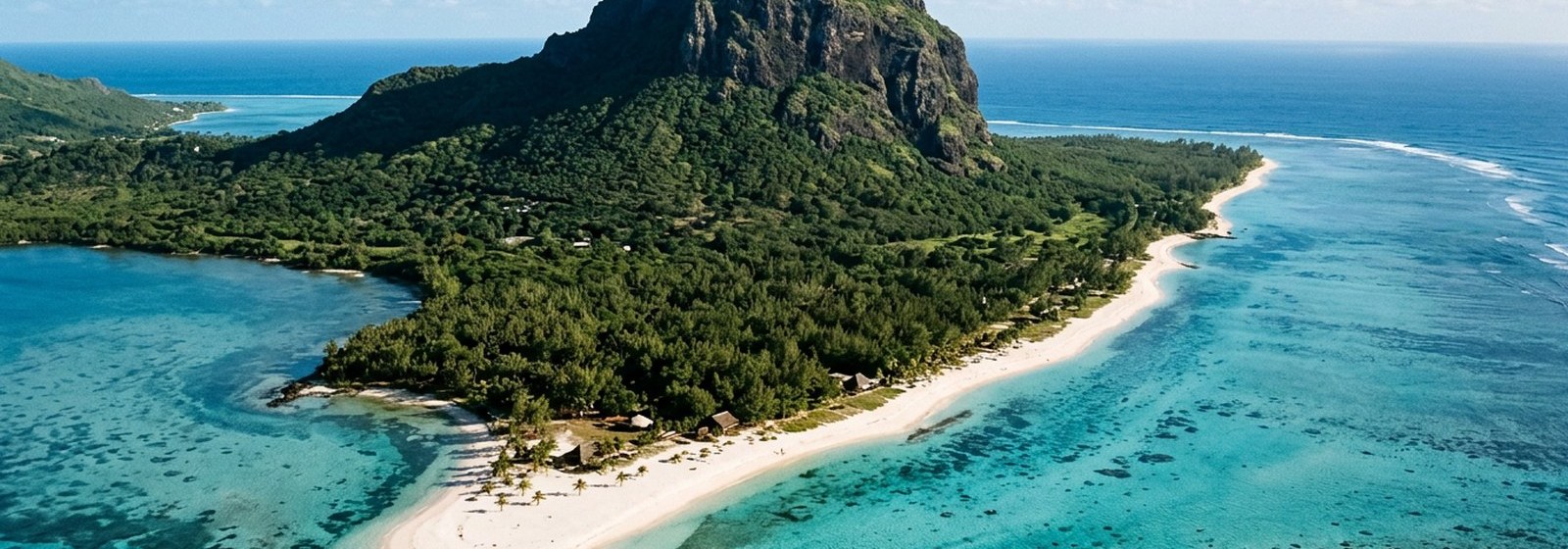
Mauritius: the Known and the Unknown Island — 18 Places, 2026 Prices and a 10-Day Route
Mauritius is known by two pictures: a turquoise lagoon and a hotel with a wristband. The real island is wider than that: in a week you can climb Le Morne Brabant, see the Seven Coloured Earths of Chamarel, eat a dholl puri for Rs 20 (≈€0.35) by the market in Port Louis, and stand alone on the rocks of Gris Gris, where the waves hit the basalt and swimming is forbidden.
We break Mauritius down in two layers: the "known" — 10 places that appear on every tour — and the "unknown" — the south coast, the villages and the second island of Rodrigues, a 1 hour 35 minute flight away. Below are live September 2026 prices, a 10-day route, and what really saves money on an island many assume is only expensive.
A day in Mauritius without an all-inclusive hotel — Rs 300–500 (≈€5.60–9) on street food, the bus Rs 17–47 (≈€0.30–0.85), an airport transfer booked in advance about Rs 2 500 (≈€46). Flights to Mauritius for October 2026: from Paris CDG €473 (28 October, 2 stops), from Madrid €449 (5 October), from Frankfurt €490. Entry to Chamarel Geopark — Rs 400 (≈€7.40), to Pamplemousses Botanical Garden — Rs 300 (≈€5.60), to the Île aux Aigrettes reserve — a benchmark of Rs 1 200 (≈€22), to Rhumerie de Chamarel — Rs 800 (≈€15). Rate on 30 September 2026: €1 ≈ 54 rupees, Rs 100 ≈ €1.85.
In brief: two Mauritiuses on one island
Mauritius is a volcanic island in the Indian Ocean, 65 km long and 45 km wide, roughly 20° south. All around it lies a coral reef and a lagoon: the island is almost entirely ringed by a protective band of reef, which keeps the water near the shore calm and shallow. Inland there's a plateau, gorges, waterfalls, and tea and sugar plantations — a part of the country no less interesting than the beaches.
- Capital — Port Louis: the market, Chinatown, Fort Adelaide, the sugar museum and Aapravasi Ghat (a UNESCO site, free entry)
- Languages — English is official, French and Creole in daily life; English is enough everywhere
- Money — the Mauritian rupee (Rs, MUR). Rate checked on 30 September 2026: €1 ≈ 54 rupees, Rs 100 ≈ €1.85
- Distances are small: from the airport in the south-east to Grand Baie in the north it's about 1.5 hours by car, and a full loop takes 2–3 days
- The island is bilingual in spirit: the north and west are touristy, the centre and south are working and rural — and that's the best part of Mauritius
The split is simple. "Known" Mauritius is the hotel coast, the lagoon, Le Morne, Chamarel and day tours. "Unknown" Mauritius is the south coast with its waves and basalt, the villages in the centre of the island, the plantations, and Rodrigues, where only a handful of the 1.3 million tourists ever go.
What a trip costs: 2026 benchmark prices
All prices below are live benchmarks checked in September 2026, except for forecasts marked separately. They aren't guaranteed for your dates: the season in Mauritius changes rates several-fold, especially in December and January.
- Flights to Mauritius — from Paris CDG €473 on 28 October 2026 (2 stops), from Madrid €449 on 5 October, from Frankfurt €490, all with 2–3 stops
- Pre-booked airport transfer — about Rs 2 500 to Grand Baie (≈€46), with a night surcharge from 23:00 to 5:00
- Guesthouse or budget hotel — from Rs 1 500–3 000 per night outside the tourist zones (≈€28–56)
- Car hire — from €18–35 a day for a small car, compact €28–50, SUV €45–75
- Bus around the island — Rs 17–47 per trip (≈€0.30–0.85), cash only, paid to the conductor
- Street food — Rs 15–30 for a dholl puri, Rs 5–10 for gato pima, a full lunch in a local eatery Rs 100–250 (≈€1.85–4.60)
- Entries: Chamarel Rs 400 (≈€7.40), Pamplemousses Rs 300 (≈€5.60), Rhumerie de Chamarel Rs 800 (≈€15), Île aux Aigrettes about Rs 1 200 (≈€22), Casela from Rs 1 525 (≈€28)
- Total for a day for two without a hotel: Rs 3 000–5 000 (≈€56–93) on the cheap, Rs 7 000–12 000 (≈€130–222) with taxis and paid entries
The simple takeaway: Mauritius is expensive only if you stay inside all-inclusive hotels. Once you leave the hotel by bus, have lunch by the market and sleep in a guesthouse, the island becomes comparable to Europe rather than twice as expensive.
Known Mauritius: 10 places everyone has heard of
1. Le Morne Brabant — the mountain that made the UNESCO list
A basalt mountain on the south-western tip, 556 metres, with almost vertical walls and a lagoon at its foot. A World Heritage Site: both a natural monument and a place of memory for the runaway slaves, the maroons, who hid on its slopes. The trail to the viewpoint is free, the climb takes about two hours, and it's best to start at 6–7 a.m., before the heat. Local guides wait at the bottom of the trail and charge by arrangement; entering the trail itself is free.
2. The Seven Coloured Earths of Chamarel
A geopark in the south-west of the island: dunes of volcanic rock that has crumbled into sand of different colours — red, purple, yellow, brown — and the colours don't mix even after rain. The ticket includes the viewpoint at Chamarel Waterfall (about 100 metres, the tallest in the country), the dune trail, an Aldabra giant tortoise park and a coffee plantation.
3. Rhumerie de Chamarel — rum tasting on the plantation
The island's only working rum distillery, running on sugar-cane juice. The tour takes 30–40 minutes and ends with a tasting of white rum, aged rum and liqueurs. An adult ticket is Rs 800 (≈€15), for 16–17-year-olds Rs 400 (≈€7.40). Open Monday to Saturday, closed on Sunday, no booking needed.
4. Port Louis and its market: the island's most "real" city
The capital, with free entry almost everywhere. The central market — vegetables, spices, vanilla, tea; the best street food on the island is right around it. Beyond that: Chinatown with buns and fried noodles, Fort Adelaide on the hill (free, with city views), and Aapravasi Ghat — the landing stage through which hundreds of thousands of Indian indentured workers passed in the 19th century, a UNESCO site, also free.
5. Pamplemousses Botanical Garden (SSR Botanical Garden)
One of the oldest botanical gardens in the southern hemisphere, founded in the 18th century, 37 hectares, giant water lilies, a lotus pond, a palm avenue and spice trees. Entry for foreign visitors is Rs 300 (≈€5.60), children under 5 free, open 8:30–17:30. A guide and the electric cart are paid separately.
6. Grand Bassin (Ganga Talao) — a sacred lake in a crater
A holy lake in an extinct volcanic crater in the south of the central island, the main pilgrimage site for the Hindus of Mauritius. Entry is free, with statues and temples nearby and viewpoints around the rim. In the Maha Shivaratri season (February) hundreds of thousands of people come here; the rest of the year it's quiet and beautiful.
7. Black River Gorges National Park
The country's largest national park: gorges, endemic forest, waterfalls and viewpoints over the west coast. Entry is free, trails are marked, and routes range from an hour to a full day. Only guided walks or 4x4 trips are paid, at a negotiable price.
8. Île aux Cerfs — the island straight off a postcard
A small island off the east coast, reached by boat from Trou d'Eau Douce and Trou-aux-Biches. A beach, monitor lizards, a golf course and cafés. The crossing itself and day tours are sold on the spot and depend on the season and group size — a benchmark is from Rs 500 (≈€9) for a return crossing; catamaran tours with lunch cost more and include several stops.
9. Casela Nature Parks — a safari park for families
A park with safari zones, tortoises, birds and extreme activities. Prices are seasonal: in low season an adult ticket is about Rs 1 525 (≈€28), in high season it rises towards Rs 1 800 (≈€33); individual activities (walking with lions, zip line, toboggan) are paid on top. If you're here for nature rather than rides, this park can be skipped in favour of the south.
10. Lagoons and beaches: Trou aux Biches, Belle Mare, Flic en Flac, Grand Baie
All four beaches are free, with public access; sunbeds and umbrellas are paid at the hotels. Trou aux Biches and Mont Choisy are in the north, a calm lagoon and tree shade. Belle Mare is the east, a long white strip and the best mornings. Flic en Flac is the west, home to long-stayers and evening sunsets. Grand Baie is the north, the liveliest spot, with shops and boat tours.
Unknown Mauritius: 8 places tour buses don't reach
This part of the island doesn't appear on standard tours — you have to get there by car or bus, and this is where Mauritius stops being a hotel poster.
1. Gris Gris and La Roche qui Pleure — the southern cliffs of Souillac
The southernmost point of the island: black basalt, cliffs, wind and the waves of the Indian Ocean with almost no reef. Swimming here is forbidden — this is a viewpoint, not a beach. Entry is free. The best time is in a heavy swell, when at La Roche qui Pleure ("the weeping rock") the water rises like a wall.
2. Rochester Falls
A wide waterfall on the Savanne River in the south of the island, framed by basalt columns. Because of the shape of the rocks, locals come here to jump into the water; the platform is small and the road runs through village streets. There's no ticket, but at the entrance a small parking fee is usually asked for, or a guide is offered.
3. Le Souffleur — the "blowhole" on the south coast
A rock slab with a channel through which, in a swell, a column of water and spray bursts out under pressure. It's a deserted spot, with no barriers and no ticket. Go only in dry weather: the rocks are slippery, and in a high swell it's dangerous to approach the channel.
4. Pointe d'Esny and Mahébourg — the south-east without giant hotels
The old fishing town of Mahébourg with its market and colonial houses, nearby Pointe d'Esny with a long beach and a Ramsar wetland, and Blue Bay Marine Park with glass-bottom boats (price negotiable, traditionally a few hundred rupees). Everything is free except the boats.
5. Ferney Valley — an endemic-species reserve
A private reserve in the south-east of the island: planted endemic forest, meadows where the world's last dodos once lived, walking trails and viewpoints. Visits are paid and sold as a guided tour; it's best to check the price on the official website before setting out, as it depends on the programme.
6. Eureka House in Moka
A 19th-century colonial house in the centre of the island, now a museum: furniture, a veranda, a pond with water lilies, a waterfall across the road. A completely un-beachy Mauritius — but here you can see how the island aristocracy lived two centuries ago. Entry is paid.
7. Villages and markets of the centre: Curepipe, Quatre Bornes, Flacq
Central towns that tourists only pass through: the Flacq market for vegetables and spices, Quatre Bornes and Rose-Hill for local eateries with roti and fried noodles, Curepipe for tea and sweets. Prices here are 2–3 times lower than at the beach, and it's the same Mauritius, without the surcharge for the view.
8. The Chamarel coffee plantation
The island's only coffee plantation — in the Chamarel highlands, on volcanic soils. The "from tree to cup" tour and tasting are sold as part of the larger "The Authentic Chamarel" ticket (Rs 2 465 for an adult, ≈€45) — so it's available, but only to those ready to pay for the full package rather than the basic entry.
Rodrigues: the second island everyone forgets
Rodrigues is a small island 600 km east of Mauritius, part of the same country but another planet: hills, narrow roads, almost no high-rise hotels, lagoons just as turquoise but with dozens of times fewer people on the beaches. Getting there — Air Mauritius, a direct flight of 1 hour 35 minutes, return from Rs 11 537 (≈€213).
- Trou d'Argent — a beach between basalt boulders, one of the most photographed, yet still empty
- François Leguat Reserve — restored forest with giant tortoises and endemic birds, a paid tour
- Port Mathurin — the market and Saturday as the main day: the whole island comes together here
- Île aux Cocos — a small nature-reserve island nearby, seabirds and snorkelling
- The weather is drier than on the main island: from May to November there's almost no rain, and the water is 24–26 °C
In practice: allow at least 3 nights on Rodrigues. Accommodation is guesthouses and small boutique hotels, cheaper than the beach hotels of the main island, but it's worth booking ahead: rooms are few, and during school holidays and public holidays they sell out completely.
Route: 7 days on the main island + 3 days on Rodrigues
- Day 1. Arrival in the south-east, Mahébourg and Blue Bay: after a night flight there's no need to cross the whole island. Overnight in Trou d'Eau Douce or Belle Mare
- Day 2. The east: Île aux Cerfs and Belle Mare lagoon, in the evening Île aux Aigrettes or a walk around Pointe d'Esny
- Day 3. On to Port Louis: the market, Chinatown, Fort Adelaide, Aapravasi Ghat, and the L'Aventure du Sucre sugar museum on the way
- Day 4. The north: Pamplemousses and Grand Baie, swimming at Trou aux Biches, in the evening boat tours and dinner on the waterfront
- Day 5. Centre and south: Grand Bassin, Black River Gorges, Chamarel Waterfall and the Seven Coloured Earths, Rhumerie de Chamarel
- Day 6. The south: Souillac, Gris Gris, La Roche qui Pleure, Le Souffleur and Rochester Falls — a full day by car
- Day 7. Le Morne Brabant at dawn, then the west lagoon and Flic en Flac; in the evening a flight to Rodrigues or a rest day
- Days 8–10. Rodrigues: Trou d'Argent, Port Mathurin, François Leguat Reserve, Île aux Cocos
If time shrinks to 5 days, it's more honest to drop Rodrigues and not try to circle the whole island: Mauritius is deceptively small on the map and slow on the roads — 60 km on a secondary road easily turns into two hours.
Flights and entry: tickets, visa-free rules, the All-in-One form
Fares from Europe mostly go with one or two stops via Istanbul, Dubai, Doha or a European hub. A search on 30 September 2026: Paris CDG — Mauritius from €473 on 28 October with 2 stops, Madrid — from €449 on 5 October, Frankfurt — from €490, all with two or three stops. December dates are one and a half to two times more expensive, because it's peak season.
- Citizens of the EU, the UK and the US don't need a visa for stays of up to 90 days; check the rules for your own country before you travel
- At the border they ask for a passport valid for at least 6 months, a return ticket, proof of accommodation and sufficient funds
- The Mauritius All-in-One Travel Digital Form is mandatory — an online form filled in ahead of time at safemauritius.govmu.org; it's free, and no paid intermediaries are needed
- A yellow fever vaccination certificate is required only if you travelled through at-risk countries
- Travel insurance isn't formally mandatory, but on an island with cyclones and surfing it pays for itself the first time you need it
One important detail about entry: the 90-days-in-180 rule counts all days of stay, including previous trips. If you've already been to Mauritius this year, a second visit may run into the limit — count the days in advance.
Transport: a bus for Rs 17, a car for €20 and taxis by negotiation
Buses
The cheapest way to see the island. The fare depends on the number of "stages" travelled: Rs 17 (≈€0.30) within a town, Rs 44 (≈€0.80) Port Louis — Grand Baie (about 47 minutes), Rs 44 Port Louis — Curepipe, Rs 47 (≈€0.85) Port Louis — Mahébourg and the longest routes across the island. You pay the conductor in cash, so you need change. Buses run from early morning until evening; timetables at the airport and on the long routes are best checked on the spot.
Car hire
The key tool for "unknown" Mauritius: without a car the south coast and the waterfalls are out of reach. 2026 benchmarks: a small car €18–35 a day, a compact or sedan €28–50, an SUV €45–75. You need a passport, a driving licence held for at least a year and a card for the deposit. The roads are narrow and winding — a compact is handier than an SUV.
Taxis and transfers
There's no meter, the price is negotiable. A short trip of 1–2 km is Rs 100–150 (≈€1.85–2.80), 10–15 km is Rs 400–600 (≈€7.40–11). From the airport: to Port Louis Rs 1 200–1 600, to Grand Baie Rs 1 800–2 500 (a pre-booked transfer is usually about Rs 2 500 or €46). Uber operates on the island and is often pricier: airport — Grand Baie came to Rs 3 546 on Uber against a fixed Rs 2 500 with local drivers.
Express metro
A light-rail train along the central corridor from Port Louis to Curepipe: handy if you're staying in the centre of the island and heading to the capital. The metro doesn't reach the beaches.
Where to stay: six coasts and their character
- North (Grand Baie, Trou aux Biches, Pereybère) — the most touristy: restaurants, shops, boat tours, pricier accommodation
- West (Flic en Flac, Tamarin, Le Morne) — sunsets, diving, dolphins and whales, but busy along the road
- East (Belle Mare, Trou d'Eau Douce) — the most beautiful lagoons and the best mornings, less nightlife, hotels mostly self-contained resorts
- South-east (Mahébourg, Pointe d'Esny, Blue Bay) — quiet, cheap, close to the airport and the reserves, windy in the southern winter season
- South (Souillac, Gris Gris) — almost no hotels: wild nature, villages, the lowest prices, and not for those who want to swim every day
- Centre (Moka, Curepipe, Quatre Bornes) — cooler, cheaper, handy for plantations and trekking, but at least 30–40 minutes from the sea
Long-term rental prices (for those staying a month or more): a one-bedroom flat outside central Port Louis — Rs 6 000–22 000 a month (≈€111–407), utilities for a flat of about 85 m² — an average of Rs 2 300 (≈€43), home fibre internet — from Rs 1 100 (≈€20), a mobile plan — about Rs 480 (≈€9), groceries for one — Rs 8 200–11 000 a month (≈€152–204).
What to eat: street food from Rs 15 to Rs 250
Mauritian cuisine is Indian, Chinese, Creole and French all at once. The cheapest and most authentic places are the Port Louis market, bus stations, the Flacq market and village eateries. In hotels and on beachfronts the same dishes cost 3–5 times more.
- Dholl puri — a thin flatbread with a split-pea filling and curry: Rs 15–30 (≈€0.30–0.60) each, a pair with fillings Rs 40–80 (≈€0.75–1.50)
- Gato pima (chilli bites) — Rs 5–10 each, about Rs 10 for three
- Samosa — Rs 5–15
- Boulettes (dumplings in broth) — Rs 50–100 (≈€0.90–1.85) a bowl
- Mine frite (fried noodles) — Rs 75–150; fried rice — Rs 90–150
- Biryani — Rs 150–250 (≈€2.80–4.60); bol renversé (rice with egg and chicken) — Rs 150–250
- Alouda — Rs 25–40; fresh coconut — Rs 75–120; water — Rs 25–60
- Daily budget: very cheap — Rs 300–500 (≈€5.60–9), a normal local day — Rs 500–900 (≈€9–17), with restaurants — Rs 900–1 500 (≈€17–28)
In practice: carry small notes. At the market and at street carts cards aren't accepted, and they often can't break a Rs 500 note for a Rs 30 purchase.
When to go: seasons, cyclones and water at 24–28 °C
- May to November — the southern winter: dry and mild, +24–28 by day, cooler at night; the best time for trekking and travelling around the island
- December to April — the southern summer: hot and humid, +27–34, short downpours, and at the same time the cyclone season
- The sea stays swimable all year round: 24–28 °C, even in the coolest month
- The most expensive dates are late December, January and the European school holidays; the cheapest are May and November
- Humidity is uneven: the most rain falls in February–March, the least in October
The practical takeaway: from May to November the island gives more for less money. If you go in December–March, budget a "weather" day and keep an eye on the cyclone forecast — in season the island sometimes closes beaches and crossings for several days.
Mistakes that cost money
- Staying only in an all-inclusive hotel: dinner in the resort leaves you without Mauritius, and a day in the same place outside the hotel costs a third as much
- Taking a taxi for every move: a week of taxis costs as much as a two-week car rental
- Not having small rupee notes: cards don't work at markets or on buses, and making change can eat into your time and money
- Heading to the southern cliffs as a beginner in a storm: Gris Gris and Le Souffleur aren't beaches, swimming is forbidden, and the rocks by the water are slippery
- Planning Rodrigues for 1–2 nights: it's a 1.5-hour flight each way, and the island opens up on the third day
- Sticking only to the hotel beaches of the east and forgetting the centre: the plantations, the market and the gorges are half the pleasure of this island
Pre-flight checklist
- Check your passport's validity: at least 6 months from the date of entry
- Fill in the Mauritius All-in-One Travel Digital Form at safemauritius.govmu.org — free, best a day before departure
- Download an offline map: mobile internet in the centre of the island is patchy, and you'll need navigation on secondary roads all the time
- Take cash: change a little into rupees straight away for food and buses
- Book an airport transfer if you land at night or with children
- Check the cyclone season and make sure your insurance covers extreme activities
- Don't forget the temple dress code: knees and shoulders covered, shoes removed at the entrance
- Set aside one day with no plans: the island is slow, and its best places are often found by accident
Frequently asked questions about Mauritius
Do EU, UK or US citizens need a visa for Mauritius in 2026?
No. Citizens of the EU, the UK and the US can enter visa-free for stays of up to 90 days; check the rules for your own country before you travel. At the border they ask for a passport valid for at least 6 months, a return ticket, proof of accommodation and sufficient funds. In addition, the Mauritius All-in-One Travel Digital Form is mandatory — an online form at safemauritius.govmu.org — and it's free.
How much does a flight to Mauritius cost from Europe?
Fares from most European cities usually involve stops via Istanbul, Dubai, Doha or a European hub. A search on 30 September 2026 showed: Paris CDG — Mauritius from €473 on 28 October (2 stops), Madrid — from €449 on 5 October, Frankfurt — from €490. December dates are one and a half to two times more expensive.
How much do the main attractions cost to enter?
The Chamarel Seven Coloured Earths geopark — Rs 400 for an adult (≈€7.40), Rs 200 for a child (includes the waterfall and the tortoise park). Pamplemousses Botanical Garden — Rs 300 (≈€5.60). Rhumerie de Chamarel with rum tasting — Rs 800 (≈€15), for 16–17-year-olds Rs 400. The L'Aventure du Sucre sugar museum — Rs 1 200 (≈€22), guide +Rs 300, rum tasting Rs 600. Île aux Aigrettes reserve — a benchmark of about Rs 1 200 (≈€22) for a non-resident, booked with the Mauritian Wildlife Foundation 5 days ahead. Beaches, Grand Bassin, Black River Gorges, Gris Gris and Port Louis are free.
Can you get around Mauritius by bus?
Yes, and it's the cheapest way: a trip costs Rs 17–47 (≈€0.30–0.85) depending on the number of stages, for example Port Louis — Grand Baie Rs 44, Port Louis — Mahébourg Rs 47. You pay the conductor in cash. The downside is time: the island is small on the map but the roads are slow. For the southern cliffs, waterfalls and villages a hired car is handier — from €18–35 a day for a small car.
How much does a day in Mauritius cost without an all-inclusive hotel?
Street food: dholl puri Rs 15–30, a bowl of boulettes Rs 50–100, biryani Rs 150–250. A very cheap day of food — Rs 300–500 (≈€5.60–9), a normal local day — Rs 500–900 (≈€9–17). A bus is Rs 17–47, a short taxi Rs 100–150. A modest day for two with food, transport and one paid entry — roughly Rs 3 000–5 000 (≈€56–93).
When is the best time to go to Mauritius?
From May to November it's the dry, mild southern winter, +24–28 by day, the best period for trekking and travelling. From December to April it's hot and humid (+27–34) and it's cyclone season. The sea is swimable all year round — 24–28 °C. The cheapest months are May and November, the most expensive are late December and January.
Is Rodrigues worth visiting?
It's worth it if you have at least 3 spare days. The Air Mauritius direct flight takes 1 hour 35 minutes, a return ticket is from Rs 11 537 (≈€213). The island has almost no large hotels, the beaches are empty, and the main places are Trou d'Argent, François Leguat Reserve, Port Mathurin and Île aux Cocos. Book accommodation in advance: rooms are few.
What should I pack and what should I be careful about?
A passport with 6 months' validity to spare, cash in small rupee notes, an offline map, modest clothing for temples, high-SPF sun protection. Be careful: don't swim by the southern cliffs of Gris Gris and Le Souffleur, don't leave things in the car at the beaches, don't drive on secondary roads after sunset, and in cyclone season follow official warnings and don't plan sea crossings for a "weather" day.