
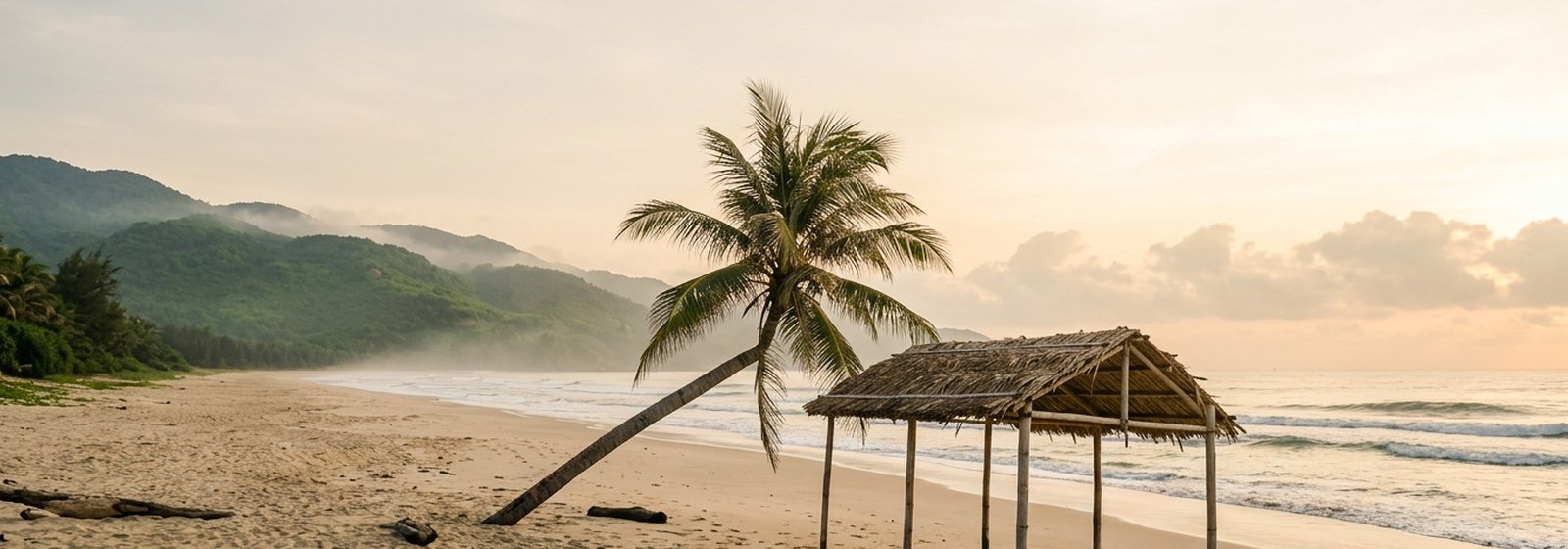
Wintering in Vietnam 2026–2027: where to live, what housing and food cost, flights, transfers and the visa
Vietnam is the most convenient country in Southeast Asia for wintering: a 90-day visa, a one-bedroom flat from ₫7 million a month, street food cheaper than cooking at home, and three climate zones — you can pick between a dry winter at +30 and a cooler one with no tourists.
We break wintering down by money and by practicalities: what a month costs in Nha Trang, Da Nang and Phu Quoc, where the rain falls in December, how long the flight takes and how to get out of the airport, how to get a 90-day visa, and which mistakes cost the most.
A couple for 30 days without flights or visa — ₫20–31 million in Nha Trang and ₫22–34 million in Da Nang. A one-bedroom rental — ₫7.2 million outside central Nha Trang and $316–482 in Da Nang, pho — ₫40,000–70,000, a motorbike — ₫1.2–2.5 million a month. Rate on 24 September 2026: ₫1 million ≈ €34 ≈ €34.
What wintering costs: benchmark prices for a month
The prices are in dong, converted at the rate of 24 September 2026 (₫1 million ≈ €34). These are living costs, without flights, visa or insurance.
- Housing: a one-bedroom outside central Nha Trang — ₫7.2 million, in the centre — ₫10.5 million; in Da Nang — $316 outside the centre and $482 in the centre
- Food: groceries plus inexpensive cafés for two — ₫10–14 million ≈ €337–473
- Motorbike and fuel — ₫2–3 million ≈ €68–101
- Phone and home internet — ₫250,000–500,000 ≈ €8–17
- Total for a couple for 30 days in Nha Trang — ₫20–31 million ≈ €677–1 041
- The same in Da Nang — ₫22–34 million ≈ €739–1 145
- Per person with shared accommodation and one motorbike — from ₫11–17 million ≈ €375–573
The most expensive time is Tet, Vietnamese New Year: in 2027 it falls on 6 February. During the week around Tet, housing and ticket prices rise and some cafés and shops close, so accommodation for that period is booked in advance.
The climate: where winter is dry at +30 and where it's rainy at +14
Vietnam stretches 1,650 km, and winter in its three parts means three different seasons. Below is actual data for December–January.
- Nha Trang: December +27 by day and +23 at night, around 276 mm of rain over 9 rainy days — the rains taper off, and from January to August it's dry and sunny
- Da Nang and Hoi An: December +25 → +19, the first half of the month is still rainy, then the weather settles down; January–February +22–26 and mostly dry
- Ho Chi Minh City and Mui Ne: dry season from December to April, +31–33 by day
- Phu Quoc: January +30 by day and +24 at night, 15–34 mm of rain for the month — dry season from November to April
- Hanoi and the north: December +21 by day and +14 at night, 7 rainy days; January +20/+13 with drizzle — you need a jacket, not shorts
- Da Lat in the mountains: +20–24 by day, sometimes +12–15 at night — the 'coolest' wintering option
The simple logic: from December to February the best wintering is in Nha Trang, Ho Chi Minh City, Mui Ne and Phu Quoc. Da Nang and Hoi An work if you sit out the first half of December: after that it's dry, cheap and almost tourist-free. The north in winter is for sightseeing, not the beach.
Where to winter: the main places
Nha Trang — the main wintering city
Six kilometres of beach along the city, mud springs, the Cham towers of Po Nagar, snorkelling islands and the most developed infrastructure for long stays: English-speaking clinics, pharmacies, cafés, gyms. A one-bedroom flat outside the centre is around ₫7.2 million a month, and a studio with air conditioning and Wi-Fi starts from $220. The sea is warm in December, though the swell can be strong.
Da Nang and Hoi An — the city by the sea
Da Nang is bigger and more convenient for work: My Khe beach, the Dragon Bridge, the Marble Mountains, international schools, plenty of cafés with power sockets. Hoi An is a yellow lantern-lit town 30 km away, cheaper to live in and better to eat in, but with less infrastructure. Rental benchmarks: a one-bedroom in Da Nang $316 outside the centre and $482 in the centre, studios $350–600 through agencies for foreigners.
Phu Quoc — the warmest option
The country's largest island: long beaches, a cable car over the sea, a night market by the port. January here is +30 by day and +24 at night with minimal rain. The downside is cost: accommodation and flights to the island are noticeably above mainland prices, and ATM coverage is thin, so withdraw cash before you fly to the island.
Ho Chi Minh City and Mui Ne — the south without rain
Ho Chi Minh City is the country's liveliest city, with a dry season from December to April: museums, Ben Thanh market, the Cu Chi tunnels. Mui Ne is a fishing village with red and white dunes and sunrises, and cheaper accommodation than the city. Both suit those who want heat in winter, not +22.
Hanoi and the north — wintering for sightseeing
In winter Hanoi is +20 by day and +13 at night with drizzle, but it's a base for Ha Long, Ninh Binh and Sa Pa, and housing and food prices are the lowest in the country. If you're going for culture and food rather than the beach, the north comes out cheaper than the south.
Da Lat — the mountain option
A former French hill station: waterfalls, coffee and tea plantations, the Truc Lam monastery. December nights are cool and you need warm clothes, but rent is cheaper than on the coast and the coffee is the best in the country.
Housing: prices and how to rent the right way
- A one-bedroom flat outside central Nha Trang — about ₫7.2 million a month, in the centre — ₫10.5 million (data from August 2026)
- A studio with air conditioning and Wi-Fi in Nha Trang — from $220 a month, a two-bedroom with a sea view in the centre — from $500
- Da Nang: a one-bedroom $316 outside the centre and $482 in the centre; studios $350–600 through agencies for foreigners, a one-bedroom $500–800
- Deposit — usually one month; electricity is almost always paid separately, and with heavy air-conditioning use that's $30–100 a month
What to do so you don't lose money
- Book the first 3–7 nights in advance and look for the monthly flat on the ground: listings on websites are priced above reality
- Don't transfer the deposit and first month to a stranger based on messages alone
- Check the water, the pressure, the air conditioning and the Wi-Fi in the exact room where you'll work, and listen to street noise in the evening
- Film the state of the flat and the appliances, and note the electricity meter reading when you move in
- Find out in advance what the rate includes (internet, cleaning, water) and whether the price changes for Tet
- Don't leave your passport as security: the legitimate substitute is a cash deposit
Food and groceries: what it costs in dong
- Pho for breakfast — ₫40,000–70,000, banh mi and com tam — ₫30,000–50,000
- Lunch at an inexpensive restaurant — ₫69,000 (range ₫40,000–150,000)
- Dinner for two at a mid-range restaurant — around ₫600,000
- Coffee with milk — ₫25,000–45,000, cappuccino — ₫43,000
- Groceries: milk 1 L — ₫37,500, bread — ₫12,000, rice 1 kg — ₫26,250, eggs 12 — ₫36,150, chicken 1 kg — ₫80,500, bananas 1 kg — ₫21,000, tomatoes 1 kg — ₫31,250, water 1.5 L — ₫10,286
Groceries plus inexpensive cafés for two — ₫10–14 million a month. The cheapest food is where locals sit on plastic stools: street pho and com, markets, banh mi. The priciest is Western breakfasts and imported groceries in tourist supermarkets.
Flights: what a winter ticket costs
Vietnam is served by direct flights from several European and Asian hubs and by dozens of one-stop routes via Istanbul, Doha, Dubai, Seoul or Guangzhou. Winter (December–February) is high season on the southern coast, so fares rise around Christmas and Tet (6 February 2027).
What the ticket search showed on 24 September 2026 (one way, October departures, cheapest fares):
- Amsterdam — Hanoi from €282, Prague — Hanoi from €343, Barcelona — Hanoi from €344, London — Hanoi from €375
- Amsterdam — Ho Chi Minh City from €290, Paris — Ho Chi Minh City from €307, London — Ho Chi Minh City from €309
- Vienna — Da Nang from €351, Prague — Da Nang from €361, Paris — Da Nang from €368
- inside Vietnam: Ho Chi Minh City — Phu Quoc and Hanoi — Phu Quoc are short domestic hops, often under €70
If your wintering isn't tied to one city, flying into Hanoi or Ho Chi Minh City and taking a domestic flight or train to the coast is usually the cheapest route. Compare prices from your own city — one-stop options are often cheaper than direct.
Transfers: how to get from the airport
Hanoi (Noi Bai): the airport is 27–30 km from the centre. Grab to the Old Quarter is ₫250,000–350,000, a Mai Linh taxi is ₫350,000–450,000, and tourist bus 86 is ₫35,000 per person. The drive takes 35–60 minutes.
Da Nang: the airport is 3 km from the centre, 5–8 km to My Khe beach, 30 km to Hoi An (35–50 minutes), 40 km to Ba Na Hills and 100 km to Hue. Grab is the cheapest: the price is fixed in the app before the trip. A pre-booked transfer DAD → Hoi An costs from €51, DAD → Hue from €51, DAD → Ba Na Hills from €18.
Nha Trang (Cam Ranh): the airport is 35 km from the city. The official taxi tariff is ₫300,000 for a 4-seater and ₫360,000 for a 7-seater, GSM — ₫350,000; bus 18 is cheaper but awkward with luggage. Grab works here too.
The visa: 90 days without leaving
Most visitors need an electronic visa (e-visa) for Vietnam. Since April 2026 it costs $25 for single entry and $50 for multiple entry, valid for up to 90 days — the official fee under Circular 28/2026 of Vietnam's Ministry of Finance.
- Apply only on the official portal evisa.gov.vn (backup address: evisa.xuatnhapcanh.gov.vn); intermediary sites charge an extra $50–100
- The 90-day multiple-entry visa is better value: a December–February wintering fits into one validity period, and trips to Cambodia or Thailand don't burn the visa
- Processing usually takes 3 working days; it's best to apply 7–10 days before departure
- An e-visa can't be extended inside the country: either exit and re-enter, or arrange a new permit through local agencies
- The passport must be valid for at least 6 months, and a photo and a scan of the data page are required
Important: since 2026 Vietnam has expanded the list of border crossings for the e-visa and added new visa categories, so check the current rules on the official portal before applying — conditions change more often than you'd think.
Money, connectivity and transport: the practical side
Money
Cards are accepted in hotels, restaurants and larger shops, but markets, small cafés and taxis are cash-only. ATMs are everywhere in the cities; fees and limits depend on your bank, so carry a second card and check the charges before you travel.
Clean dollars or euros are the reliable fallback: change a small amount at the airport for the first day and the rest in town or at a bank. On Phu Quoc, in Da Lat and in Mui Ne withdraw cash in advance — ATM coverage is thinner there.
Connectivity
A Viettel tourist SIM is ₫100,000–300,000 for 30 days with internet, registered with a passport at a shop or at the airport. Home internet in a flat is around ₫242,500 a month, and a mobile plan with 10 GB is ₫168,750. If you'd rather not spend your first day at a shop, get an eSIM in advance.
Transport
A motorbike is a winterer's main transport: a budget 100–125 cc scooter costs ₫1.2–1.8 million a month, a mid-range one ₫1.8–2.5 million, a premium one ₫3–4.5 million. Petrol is ₫22,000–25,000 a litre, and a scooter uses 2–2.5 L per 100 km. The deposit is usually ₫1–5 million — don't leave your passport as security. Around town, Grab is cheaper: ₫20,000–40,000 per ride, a bus ₫8,000.
What to see over the wintering season
Over three months of wintering you get to both live and travel. From Nha Trang — Da Lat, Mui Ne and Ho Chi Minh City; from Da Nang — Hoi An, Hue, the Hai Van Pass, the Marble Mountains and Ba Na Hills; from the north — Ha Long, Ninh Binh and Sa Pa. An overnight Ha Long cruise costs €25–60 per person, the Hue citadel around ₫200,000, Hoi An's Old Town ₫120,000, and the Ba Na Hills cable car about ₫900,000.
Three mistakes that cost the most
- Applying for a 30-day visa. The minimum e-visa term is 90 days, and the $50 multiple-entry version covers the whole season: you can't re-apply inside the country, you'd have to leave
- Planning a move or an arrival for Tet. In 2027 Vietnamese New Year is 6 February: tickets, housing and transport get more expensive and some places close for a week
- Leaving your passport as security for a motorbike or a flat. This is the most common story of losses: the legitimate substitute is a ₫1–5 million cash deposit
Pre-departure checklist
- A 90-day e-visa applied for on evisa.gov.vn, printout with you
- Passport valid for at least 6 more months
- First 3–7 nights of accommodation booked, the rest found on the ground
- Cash dollars or euros plus a foreign bank card; for Phu Quoc and Da Lat, cash in advance
- Insurance covering motorbike injuries — a separate clause in the policy
- A Viettel SIM or an eSIM before departure
- An international driving permit if you plan to ride; a helmet is mandatory
- First-aid kit, repellent, bottled water only
Vietnam is great for wintering because you don't have to choose between 'cheap' and 'comfortable': a flat by the sea, a motorbike and street food fit into a budget that back home goes on utility bills.
FAQ
How much does wintering in Vietnam cost per month?
A couple spends ₫20–31 million over 30 days in Nha Trang and ₫22–34 million in Da Nang — without flights, visa or insurance. The breakdown: housing ₫7.2–10.5 million, food ₫10–14 million, motorbike and fuel ₫2–3 million, connectivity ₫250,000–500,000.
Where in Vietnam is it dry and warm in winter?
Nha Trang (December +27/+23, then dry through August), Ho Chi Minh City and Mui Ne (dry season December–April, +31–33), Phu Quoc (January +30/+24, 15–34 mm of rain). Da Nang and Hoi An work from the second half of December, while Hanoi in winter is +20/+13 with drizzle — not a beach.
How much does renting a flat for a month cost?
Nha Trang: a one-bedroom outside the centre around ₫7.2 million, in the centre ₫10.5 million; a studio with air conditioning from $220, a two-bedroom with a sea view from $500. Da Nang: a one-bedroom $316 outside the centre and $482 in the centre. The deposit is usually one month, electricity separate ($30–100 with air conditioning).
What visa do I need and for how long?
An electronic visa (e-visa) for up to 90 days: $25 for a single-entry and $50 for a multiple-entry visa, official portal evisa.gov.vn. Processing takes about 3 working days. It can't be extended inside the country: only exit and re-entry.
How much is a flight to Vietnam?
Search of 24 September 2026 (one way, October departures): Amsterdam — Hanoi from €282, Prague — Hanoi from €343, Barcelona — Hanoi from €344, London — Hanoi from €375; Amsterdam — Ho Chi Minh City from €290, Paris — Ho Chi Minh City from €307, London — Ho Chi Minh City from €309; Vienna — Da Nang from €351, Prague — Da Nang from €361, Paris — Da Nang from €368. Inside Vietnam, domestic hops such as Ho Chi Minh City — Phu Quoc are often under €70.
How do I pay in Vietnam?
Cards work in hotels and larger venues, but markets, small cafés and taxis are cash-only. Bring clean dollars or euros plus a second card as backup, and check your bank's foreign transaction fees before you travel. Small notes matter: change is often scarce.
How much does a motorbike cost and do I need a licence?
A budget scooter is ₫1.2–1.8 million a month, a mid-range one ₫1.8–2.5 million, a premium one ₫3–4.5 million; petrol is ₫22,000–25,000 a litre. A helmet is mandatory and an international driving permit is required: both the police and the insurer check it. Don't leave your passport as security — a cash deposit only.
When is Tet in Vietnam and how does it affect wintering?
Vietnamese New Year 2027 falls on 6 February. In the week around Tet, housing and ticket prices are higher, some cafés and shops are closed and transport is packed. Book accommodation and domestic flights for that period in advance.