
Vietnam on a budget: all the top destinations, islands and a 3-week route
Vietnam is one of the cheapest countries in Asia for travelling on your own: a bowl of pho for a dollar, egg coffee for a buck and a half, guesthouses from €8 and trains that carry you the length of the country for pennies.
Here you'll find Hanoi's narrow street-food lanes, the thousand islands of Halong Bay, the rice terraces of Sapa, the imperial citadel of Hue, yellow Hoi An with its lanterns, the Golden Bridge in Da Nang, the sand dunes of Mui Ne and the Mekong Delta.
We've gathered every main destination with price benchmarks and money-saving tips, plus a three-week route that follows the classic line from north to south, so you never have to backtrack.
Vietnam is one of the cheapest countries in Asia for travelling on your own: a bowl of pho for a dollar, egg coffee for a buck and a half, guesthouses from €8 and trains that carry you the length of the country for pennies.
What to see: the main destinations
Hanoi
A capital with a thousand years of history: Hoan Kiem Lake with Ngoc Son temple on its island, the Old Quarter with its 36 craft streets, the Temple of Literature, the Ho Chi Minh mausoleum and the train that passes centimetres from the houses on Tran Phu street.
Tickets: guesthouse €8–15, pho 40,000–70,000 dong · 3 days
Money-saving tip: Eat where people sit on little plastic stools: bun cha, pho, banh mi — 30,000–70,000 dong. Look for egg coffee in the Old Quarter's alleyways, not on the lakeside.
Halong Bay and Bai Tu Long
Thousands of limestone peaks rising out of the water, grottoes, floating villages and sunsets that look painted. Cruises leave from Halong and from Cat Ba island, some of them through the quieter Bai Tu Long Bay.
Tickets: overnight boat tour from €25–60, bay entry fee extra · 2 days
Money-saving tip: Book an overnight boat tour, not a day trip: for the same money you get sunset, sunrise and kayaking. Compare operators — prices differ by double for the same route.
Sapa and the rice terraces
Mountains on the Chinese border: the stepped rice fields of the Muong Hoa valley, Hmong and Dao villages, the Bac Ha market on Sundays, Thac Bac waterfall and Fansipan peak — the roof of Indochina at 3,143 metres.
Tickets: train or bus from Hanoi €8–15, guided trek €15–30 a day · 2–3 days
Money-saving tip: Trek with a local guide from a village — cheaper than an agency, and the money stays in the valley. The night train from Hanoi saves a hotel night and costs about the same as the bus.
Ninh Binh
"Halong on land": boat rides along the river between karst cliffs at Tam Coc and Trang An, where the rowers use their feet, the Hang Mua panorama from the Mua Cave viewpoint, the ancient capital of Hoa Lu and Bai Dinh pagoda — the country's largest temple complex.
Tickets: bus from Hanoi €5–8, boat 200,000–300,000 dong · 2 days
Money-saving tip: Rent a bicycle (around 100,000 dong) and ride through the villages yourself: the same views as a tour, without the group. Boat prices are fixed, so there's little room to haggle.
Hue
The imperial capital of the Nguyen dynasty: the citadel with its Forbidden City, palaces and pavilions, the tombs of emperors Tu Duc and Khai Dinh, Thien Mu pagoda and the Perfume River with its dragon boats.
Tickets: citadel entry by ticket, around 200,000 dong · 2 days
Money-saving tip: Buy a combined ticket for the citadel and the tombs — cheaper than paying separately. In the evening cycle to the pagoda: entry is free and the sunset over the river is the best in town.
Hoi An
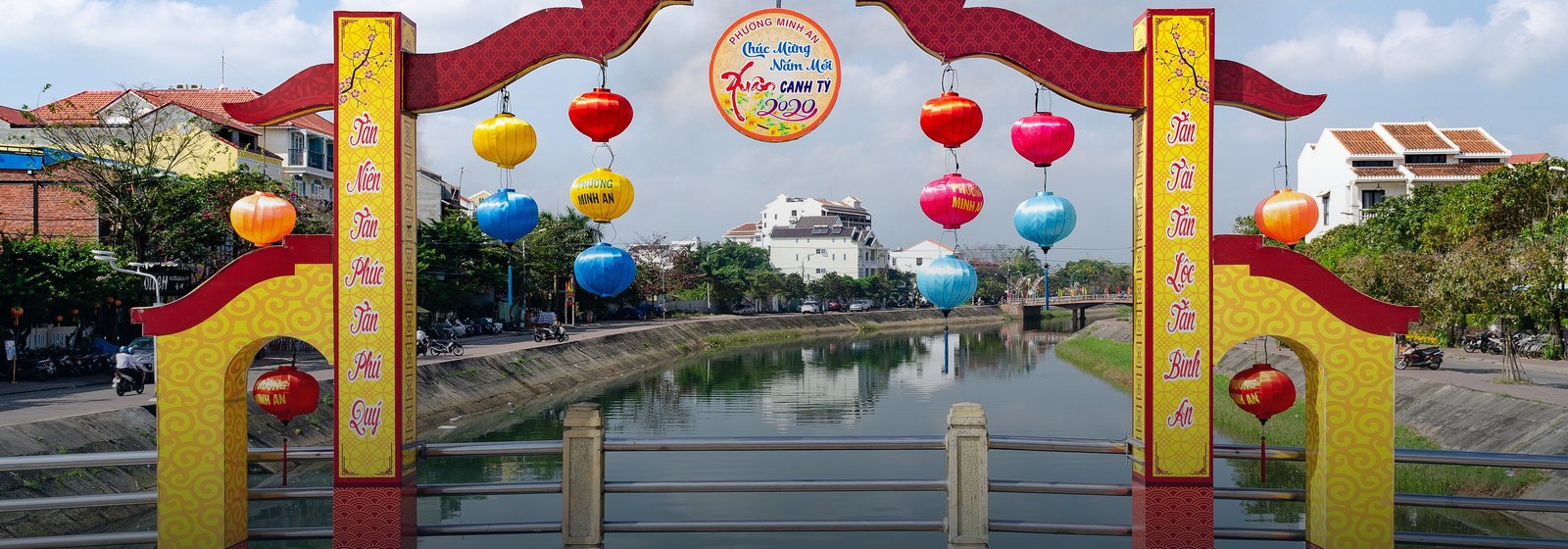
The 16th-century old town: yellow merchant houses, the Japanese covered bridge, the Quan Cong hall, lanterns over the Thu Bon river and tailors who will run up a suit or a dress to your measurements in a day.
Tickets: Old Town entry is a combined ticket, around 120,000 dong · 3 days
Money-saving tip: The riverside and the market are free to walk — the ticket is only for the historic houses and the bridge. Order a suit from a tailor away from the centre: prices are a third lower for the same quality.
Da Nang and the Golden Bridge
A seaside city with the Dragon Bridge that breathes fire at weekends, My Khe beach, the Marble Mountains with their caves and shrines, and the Golden Bridge at Ba Na Hills — giant stone hands holding a walkway 1,400 metres up.
Tickets: taxis and Grab are cheap, Ba Na Hills cable car around 900,000 dong · 2 days
Money-saving tip: Get to Ba Na Hills on your own: a round trip by Grab is cheaper than an organised tour, and buy the cable car ticket online. The Marble Mountains and the beach are free.
Nha Trang
A resort with a 6-kilometre sandy beach, mud baths, snorkelling islands, the Cham Ponagar towers and the Kim Thien statue on the hill, plus the Vinpearl complex on its own island.
Tickets: accommodation from €10–20, bus from Ho Chi Minh City €10–15 · 3–4 days
Money-saving tip: The beach is free, sun loungers aren't. Go to Thap Ba for the mud springs — cheaper than the city baths. The four-island tour is the most overpriced thing here: pick one island and stay until sunset instead.
Da Lat
A town in the mountains where the French used to escape the heat: lakes, the Datanla and Prenn waterfalls, coffee and tea plantations, the Crazy House, the Valley of Love, the Truc Lam Buddhist monastery and trails up to the peaks.
Tickets: flight or bus, accommodation from €10 · 2–3 days
Money-saving tip: Coffee here costs a third of what it does in tourist towns. Rent a bike for a day and ride to the waterfalls: there's almost no public transport between them.
Mui Ne and the sand dunes
A fishing village with red and white sand dunes where people ride quad bikes and jeeps, the Fairy Stream, a red-sand canyon with a creek running through it, a seafood market and sunrises that begin with the boats heading out.
Tickets: bus from Ho Chi Minh City €5–8, accommodation from €8 · 2–3 days
Money-saving tip: The "sunrise on the white dunes" day tour costs €5–10 and starts at 4:30 — cheaper than getting there yourself. Buy fish and squid at the morning market and have them cooked next door.
Ho Chi Minh City (Saigon)
The liveliest city in the country: the red-brick Notre-Dame Cathedral, the Gustave Eiffel post office, the War Remnants Museum, the Reunification Palace, Ben Thanh market, the Binh Thien quarter and the Cu Chi tunnels underground nearby.
Tickets: accommodation €10–20, food 40,000–80,000 dong · 2–3 days
Money-saving tip: Do the Cu Chi tunnels as a half-day trip with a local guide — cheaper than the full-day tour and without the forced souvenir-shop stops. Get around by Grab, not the taxis outside hotels.
The Mekong Delta (Can Tho, Ben Tre)
River country: the Cai Rang and Cai Be floating markets at dawn, boats through the narrow canals of Co Do, coconut and mandarin orchards, the Huynh Thuy Le house-museum, and cocoa and coconut sweets made by hand.
Tickets: bus from Ho Chi Minh City €3–6, boat and overnight stay €10–25 · 2 days
Money-saving tip: See the floating market between 5:30 and 7:00 — after that it shuts down. Stay in a family guesthouse in Ben Tre: meals and bicycles are included and it costs less than a hotel in Can Tho.
Phu Quoc
The largest island in the country: the long Sao and Long Beach stretches, a cable car over the sea to Hon Thom, diving and snorkelling, a working fish-sauce workshop and a night market by Duong Dong harbour.
Tickets: flight from Ho Chi Minh City, accommodation from €15 · 4–5 days
Money-saving tip: The beaches are public and free, the loungers aren't. A fish dinner at the night market costs half what it does at the beach restaurants. Book flights with luggage included in advance — otherwise the extra fee eats your savings.
Phong Nha and its caves
A national park with hundreds of caves: Thien Duong (Paradise), Phong Nha — the biggest cave in the world after Hang Son Doong (which only organised tours reach), jungle trails and cliff-top viewpoints.
Tickets: national park entry around 250,000 dong, Son Doong tours are expensive · 2 days
Money-saving tip: You can visit Thien Duong cave on your own with a ticket — cheaper than a tour. The expedition tours require real fitness and cost a lot, but the short treks in the park are open to everyone.
Hai Van Pass and Lang Co lagoon
The stretch of coast between Da Nang and Hue: Lang Co lagoon with its oyster farms, long empty beaches, the Hai Van Pass with its panorama of the bay and marble cliffs.
Tickets: ferry/taxi, bike rental €5 a day · 1–2 days
Money-saving tip: Ride the Hai Van Pass on a bike rather than in a tourist bus: the stops are free, the views are the same, and the cafés at the viewpoint are cheaper than in Da Nang.
An Bang and Cua Dai beaches
Two beaches near Hoi An: An Bang with its cafés and parasols, and Cua Dai — empty and almost village-like, with fishermen, cows by the water and coconut groves. People come here for a calm sea without crowds.
Tickets: free · 1 day
Money-saving tip: Sun loungers in An Bang cost money; in Cua Dai you can lie on your towel for free. Renting a bike for the day is cheaper than two round trips by Grab.
Cu Chi and the south
Underground tunnels stretching 200 kilometres, where during the war villages lived with kitchens, hospitals and workshops. Nearby are the Cao Dai temple and rubber plantations.
Tickets: half-day tour €8–15 · half a day
Money-saving tip: Take the half-day tour rather than the full day: it's the same thing without the stops at tea and craft shops. Getting there by public bus is cheaper, but the guide's explanations are what make the place make sense.
Free and off the beaten path
- Wandering Hanoi's Old Quarter — Hoan Kiem Lake, the 36 craft streets, the markets and the street food — no ticket needed, and in the evening musicians play along the lake.
- The beaches of Da Nang, Nha Trang and Phu Quoc — Every beach is public and free: My Khe, An Bang, Sao, Cua Dai. Only loungers and parasols cost money.
- Night and morning markets — The cheapest way to eat: the morning market in Mui Ne, Ben Thanh in Ho Chi Minh City, the Duong Dong night market on Phu Quoc.
- The Marble Mountains and Thien Mu pagoda — The caves of the Marble Mountains and the pagoda near Hue give you the views and the atmosphere without big ticket prices.
- Trekking in Ninh Binh and Hoang Lien — Trails to viewpoints and villages around Ninh Binh, the rice fields of Sapa and mountain routes — you only pay for transport and a guide.
3-week itinerary
Week 1
The north: Hanoi — Halong — Sapa — Ninh Binh. Three days in the capital with the lake and the Old Quarter, an overnight boat cruise on Halong or Bai Tu Long, the night train to Sapa with trekking through the terraces, then Ninh Binh with its boats and the Mua Cave viewpoint. Transport: sleeper buses, trains, boats.
Week 2
The centre: Hue — Da Nang — Hoi An. The imperial citadel and the tombs, then the Hai Van Pass and the Marble Mountains, the Golden Bridge at Ba Na Hills, My Khe and An Bang beaches, and Hoi An's old town with its lanterns and tailors. Transport: the Hue–Da Nang train (the best railway view in the country), Grab, a bike.
Week 3
The south: Nha Trang or Da Lat — Mui Ne — Ho Chi Minh City — the Mekong Delta. Seaside Nha Trang with its mud baths or mountain Da Lat with waterfalls and coffee, then the Mui Ne dunes at sunrise, Ho Chi Minh City with its museums and the Cu Chi tunnels, finishing with the Mekong Delta floating market and a night in a guesthouse. Transport: sleeper buses, low-cost flights, boats.
Getting there
Gateways: Hanoi (HAN) in the north and Saigon (SGN) in the south — VietJet flights between them run $15–25. The classic move is flying into one end and travelling overland north → south or the reverse.
Food
- Pho and banh mi from street carts — €1–1.5
- Bun cha in Hanoi, banh mi everywhere — €1–2
- Eat on the little plastic stools: local turnover is the freshness filter
Transport
Night trains and sleeper buses link Hanoi, Danang and Saigon for €10–20. In cities, Grab motorbikes beat taxis on price and speed. Scooter rental from 150,000 dong a day — an IDP is required.
Where to stay
Guesthouses €8–12; 3* pools from €25. Hoi An is cheapest in shoulder season, Phu Quoc in dry season. Book free-cancellation rates.
FAQ
How much does a day in Vietnam cost?
€20–35: accommodation €8–15, food €5–8 (pho and banh mi on the street), transport €2–4, activities €5–10. The north and centre are cheaper than the south and the islands.
When should you go to Vietnam?
The country is long and the seasons differ: the north (Hanoi, Sapa) is October–April; the centre (Hue, Hoi An) February–August; the south (Ho Chi Minh City, Phu Quoc) December–April. March–April works anywhere.
Do you need a visa for Vietnam?
Most tourists need an e-visa, applied for online before the trip. Conditions and processing times change — check the official immigration website before you fly.
What's the cheapest way to get around the country?
Sleeper buses between cities (€5–15 for a night ride), trains for shorter hops, VietJet and Bamboo low-cost flights booked early, and in cities Grab plus bike rental at €5 a day.
What should you eat in Vietnam and what does it cost?
Pho, banh mi, bun cha, com tam, banh xeo — 30,000–70,000 dong. The cheapest places are morning markets and stalls where locals eat; egg coffee with condensed milk is 20,000–40,000 dong.
Is riding a motorbike dangerous?
It's the most convenient transport and also the biggest risk: wear a helmet, check the brakes, don't ride on highways at night and never leave your passport as a rental deposit.
Is Phu Quoc worth it, or is Nha Trang better?
Phu Quoc is an island with beaches and diving, but the flight makes it pricier; Nha Trang is cheaper, closer to the route and has mud baths and islands. To save money, pick Nha Trang or Mui Ne.
How do you save money on tours?
Book locally rather than online; choose a half day instead of a full day; and get around yourself by bike or Grab wherever you don't need a guide (the Mui Ne dunes, the Marble Mountains, the beaches).