
Bangkok on a Budget: Top Sights, 15-Baht Boats, and Street Food
Bangkok often scares people off with its prices: skyscraper hotels, "observation decks at 900 baht", tourist cruises at 2,000 baht. In reality it is one of the cheapest big cities in Asia - if you know where to walk, what to ride, and what is worth going inside versus admiring from the outside.
This article is not a list of "top 10 Instagram spots" but a working plan: 18 key places with approximate prices and insider tips, 5 free corners that almost no tourists reach, and a ready-made 3-day itinerary that does not require a single taxi.
All prices are approximate, check the official site before you travel: tickets and opening hours change every season.
Bangkok often scares people off with its prices: skyscraper hotels, "observation decks at 900 baht", tourist cruises at 2,000 baht. In reality it is one of the cheapest big cities in Asia - if you know where to walk, what to ride, and what is worth going inside versus admiring from the outside.
What to see: the main sights
Wat Pho (Temple of the Reclining Buddha)
A 16th-century temple: a 46-metre gilded Reclining Buddha with mother-of-pearl inlay on the soles of its feet, plus one of the largest collections of Buddha images in the country. It is also home to a traditional Thai massage school, so you can book an hour-long session and see for yourself why Thai massage made the UNESCO list. The temple sits right next to the Grand Palace, so it makes sense to pair the two in one morning. Come at opening time: by 10:00 the flag-waving tour groups arrive.
Tickets: Entry - approx. 200-300 baht (about 5-8 EUR); approximate, check the official site · 1.5-2 hours
Money-saving tip: Be at the gate at 8:00-8:30 - it is cool, there is almost no one around, and your photos of the Reclining Buddha come out crowd-free. Bring your own water: at the stalls by the temple it costs two to three times what it does at 7-Eleven.
Wat Arun (Temple of Dawn)
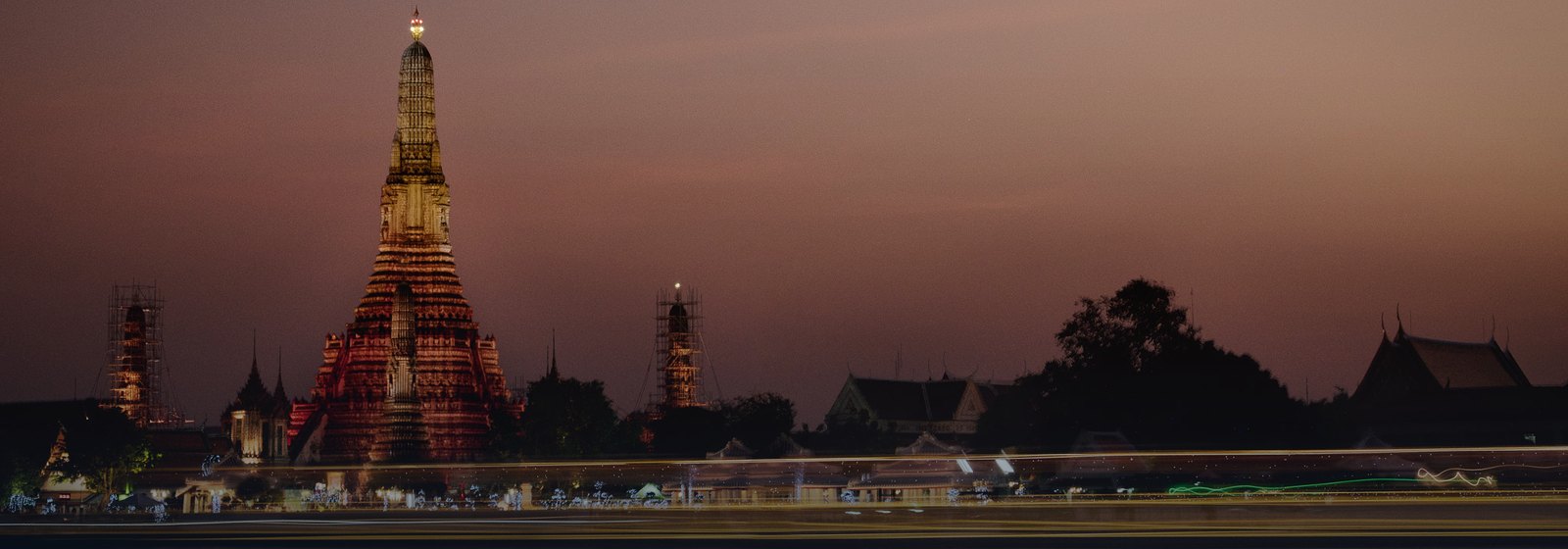
A tall prang on the west bank of the Chao Phraya, clad in fragments of porcelain and ceramic: a steep staircase takes you up to the middle tier. The temple already existed in the Ayutthaya period and took its present form under Rama II and Rama III. The best shots are from the ferry and from the opposite bank at sunset, when the tower is lit up. Inside the courtyard there are quiet corners with Buddha figures and hardly any queues.
Tickets: Entry - approx. 100-200 baht (about 3-5 EUR) · 40-60 minutes + ferry
Money-saving tip: The cross-river ferry from Tha Tien pier costs about 5 baht - it is the cheapest "cruise" in town. Do not buy the 200-baht tourist boat: same view, just pricier and with a guide.
The Grand Palace and Wat Phra Kaew
The official residence of the kings and the most visited complex in the country: golden pavilions, throne halls, and Wat Phra Kaew with the Emerald Buddha carved from a single block of stone. Three times a year the keeper changes the figure's seasonal robes, and the ceremony is a spectacle in itself. The complex opens in the morning and closes around 15:30, so make it the first stop of your day, not the last. Inside there are free drinking fountains and a hall where you can rest in the shade.
Tickets: Entry - approx. 500 baht for foreign visitors (about 13 EUR) · 2-3 hours
Money-saving tip: The dress code is strict: shoulders and knees covered. If you turn up in shorts, a sarong is handed out free at the entrance - do not buy the "special" trousers from street vendors for 200 baht.
Wat Saket (Golden Mount)
An artificial hill topped with a golden chedi: a spiral staircase of roughly 300 steps leads up, surrounded by bells that people ring as they climb. From the top you get a 360-degree panorama of the Old City - the Grand Palace, temple roofs, and skyscrapers on the horizon. It is a working temple, so locals come here to pray, not only tourists. It is about a 15-minute walk from Khaosan Road.
Tickets: Free entry, donations welcome · 30-40 minutes
Money-saving tip: Come 40-50 minutes before sunset: the climb is free and the view is the best free lookout in Bangkok. That is money saved on paid observation decks.
Wat Traimit (Golden Buddha)
Home of the Golden Buddha: a figure weighing about 5.5 tonnes and standing some three metres tall, cast back in the Sukhothai period. For years it was taken for an ordinary stuccoed statue - the gold was only discovered in the 1950s, when the plaster cracked during a move. The temple stands at the very start of Yaowarat, so it pairs easily with Chinatown. On the upper floor there is a small exhibition about the statue's history.
Tickets: Entry - approx. 100 baht (about 3 EUR) · 30 minutes
Money-saving tip: Walk from Ratchawong pier or from MRT Wat Mangkon: in the evening Chinatown sits in endless traffic jams, while on foot you will be there in 10 minutes and save the taxi fare.
Khaosan Road and Banglamphu
The legendary backpacker street: cheap guesthouses, barbecue carts, live-music bars, and tuk-tuks on every corner. It is not the "real" Bangkok, but it is the easiest place to meet other travellers and eat for 60-80 baht. Nearby are quiet lanes with nice cafés, old wooden houses, and a riverside exit at Phra Athit pier. From here it is easy to start walking into the Old City.
Tickets: Walking is free; a beer in a bar - approx. 80-150 baht (about 2-4 EUR) · Evening, 2-3 hours
Money-saving tip: Eat in the neighbouring Soi Rambuttri rather than on Khaosan itself: the same dishes cost 20-30% less and there is less noise. Buy your alcohol at 7-Eleven, but bear in mind you cannot drink on the street everywhere.
Yaowarat (Chinatown)
The main street of Thailand's Chinese community, which in the evening turns into one long open-air food court. Grilled seafood, fried squid, duck noodles, sticky rice with mango, and permanent queues for the local sweets. By day it is worth dropping into Sampheng Market - a narrow street of fabrics, toys, and odds and ends at laughable prices. The area is loud, stuffy, and absolutely unmissable.
Tickets: Free; a street-food dinner - approx. 100-200 baht (about 3-5 EUR) · Evening, 2-3 hours
Money-saving tip: Come at 18:00-19:00, when the carts are just setting up: the food is fresh, the queues are shorter, and the prices are the same. Cash is essential - half the stalls do not take cards.
Chatuchak Market
One of the biggest weekend markets in the world: more than 8,000 stalls selling clothes, plants, vinyl, ceramics, and food. You can genuinely buy a T-shirt for 100 baht and spend half a day without seeing the same thing twice. It runs mainly on Saturdays and Sundays from morning to evening; on weekdays only some sections are open. The easiest way there is the MRT to Kamphaeng Phet - the exit leads straight into the market.
Tickets: Free entry; food - approx. 50-150 baht (about 1.5-4 EUR) · 3-5 hours, Saturday and Sunday
Money-saving tip: Arrive at opening, around 9:00: the heat is gentler, the vendors are more open to bargaining, and by midday the crowd gets dense. Save the section map to your phone - without it you will easily walk 15 km in circles.
Siam, MBK, and BACC
The city's transport and shopping hub: Siam Paragon, Siam Center, Siam Square, and the old MBK Center all within five minutes' walk of each other. MBK is the cheapest place in town to fix a phone, buy a case, or eat in the huge top-floor food court. Next door is the free Bangkok Art and Culture Centre with exhibitions and air conditioning - the perfect refuge from the heat. Everything is linked by walkways to BTS Siam and National Stadium.
Tickets: Free; food in the food court - approx. 50-100 baht (about 1.5-3 EUR) · 2-3 hours
Money-saving tip: In the MBK food court you first buy a coupon at the cash desk, then pay with it at the stalls: a plate of rice with chicken comes to about 50 baht - half what you would pay in a café one floor down.
Lumphini Park
A big green park in the business district with a lake, a running track, and free outdoor gym equipment. The real local stars are the large monitor lizards that wander calmly across the lawns and swim in the pond. Around 18:00 hundreds of people do aerobics to music, and anyone can join in. The nearest stations are MRT Lumphini and BTS Sala Daeng.
Tickets: Free · 1-2 hours, best in the morning
Money-saving tip: Go before 9:00: it is cooler, the monitor lizards are active, and the gym equipment is free. Fill your bottle at the park's free fountains instead of buying water for 20 baht at the entrance.
Jim Thompson House
A complex of six old teak houses that the American entrepreneur Jim Thompson assembled and brought to Bangkok, reviving Thai silk as an export. Inside are antiques, Chinese porcelain, and the feel of a lived-in home rather than a museum with labels. Visits are guided, and it is genuinely interesting: you hear about silk, trade, and Thai traditions. The garden has turtles and a small workshop.
Tickets: Entry - approx. 200 baht (about 5 EUR) · 1-1.5 hours
Money-saving tip: The nearest station is BTS National Stadium, a 5-minute walk; a taxi from the Old City will cost more than the ticket itself. While you are there, look into Kasemsan Lane with its inexpensive local cafés.
Chao Phraya boats
The river is the city's main sightseeing line: an orange-flag boat passes the Grand Palace, Wat Arun, and Chinatown. The ride costs about as much as a cup of coffee, beats a taxi stuck in traffic, and doubles as a river tour. There are also the khlongs, with boat "buses" out to the Banglamphu area. You pay the conductor on board, and the ticket is issued on the spot.
Tickets: Approx. 15-20 baht per express boat ride (about 0.4-0.5 EUR); a tourist boat day pass - approx. 150 baht · 30-60 minutes
Money-saving tip: Do not mix up the boats: at the pier they offer a "cruise" for 1,500-2,000 baht, while the ordinary orange-flag express costs 15-20 baht. Just tell the cashier the pier you want.
Asiatique and ICONSIAM
Two spots on the Chao Phraya that locals reach by free shuttle boat: Asiatique is a night market in retro warehouses with a Ferris wheel, and ICONSIAM is a huge mall with Sook Siam, a zone styled after a floating market. Sook Siam gathers street food from all over the country under one roof, and the prices there are quite reasonable. In the evening both places are prettily lit, and the riverside promenade opens onto the water. It is a great free "walk with air conditioning" when it is hot.
Tickets: Free entry; food - approx. 100-300 baht (about 3-8 EUR) · Evening, 2-4 hours
Money-saving tip: The shuttle boat to ICONSIAM from Sathorn pier (BTS Saphan Taksin) is free - a mini river trip in itself. Do not get on the paid "dinner cruises" if you simply want to see the city.
Talad Rot Fai (Train Market)
A night market built out of retro hangars: vintage furniture, old signs, records, Thai street food, and bar courtyards with live music. The easiest option is Ratchada behind the Esplanade mall, by MRT Thailand Cultural Centre; the bigger Srinakarin one needs a taxi. It runs in the evenings, usually Thursday to Sunday. The atmosphere is far calmer than Chatuchak, and there are fewer tourists.
Tickets: Free entry; food - approx. 60-150 baht (about 1.5-4 EUR) · Evening, 2-3 hours
Money-saving tip: Take the MRT to Thailand Cultural Centre - that is 15-20 minutes and about 30 baht from the centre. Keep small change on you: some stalls will not give change for large notes.
Mahanakhon SkyWalk
An observation deck on the 78th floor of King Power Mahanakhon: a glass floor and a panorama of the river and the whole city from more than 300 metres up. The ticket costs more than anything else on this list, so treat it as an alternative to paid tours rather than an everyday thing. Sunset slots usually cost more than daytime ones, but the view is worth the money. The nearest station is BTS Chong Nonsi.
Tickets: Entry - approx. 800-900 baht (about 21-24 EUR); approximate, check the official site · 1-1.5 hours
Money-saving tip: If your budget is really tight, swap it for the free view from the Golden Mount or a mall rooftop. And you can walk into the King Power mall below for free - there are often promotions and free Wi-Fi.
Ayutthaya (day trip)
The ancient capital, 80 km from Bangkok and a UNESCO site: the ruins of Wat Mahathat with its famous Buddha head wrapped in tree roots, Wat Chaiwatthanaram, and Wat Phra Si Sanphet. The cheapest way to get there is the ordinary train - the most budget-friendly "express" in travel history. Once there, rent a bicycle or a tuk-tuk for a couple of hours and loop round the main sights. In the evening you are back in Bangkok in time for dinner.
Tickets: Train - approx. 20-40 baht one way (about 0.5-1 EUR); temple entries - approx. 50-100 baht · Full day
Money-saving tip: Trains leave from Krung Thep Aphiwat station (Bang Sue), some from Hua Lamphong: check the timetable on the official site. A third-class ticket costs a few dozen baht - buy it at the station, not the 1,500-baht tour.
Kanchanaburi and Erawan Falls
A trip to the seven-tier Erawan waterfall with turquoise pools you can swim in, and to the bridge over the River Kwai and the "Death Railway". This is no longer the city: jungle, trains on wooden bridges, and fishing boats. It is doable in a single day, but an overnight stay in a cheap guesthouse is calmer and not much pricier. Bring a swimsuit - the upper tiers of the waterfall feel like natural pools.
Tickets: Bus or minivan round trip - approx. 300-500 baht (about 8-13 EUR); waterfall entry - approx. 300 baht · Full day or 2 days
Money-saving tip: Minivans leave from Mo Chit station and from Khaosan Road; agree the price with the driver up front. Swim at the upper tiers - fewer people, but a longer climb.
Floating markets: Damnoen Saduak and Amphawa
Damnoen Saduak is the classic morning floating market about an hour and a half from the city: boats with noodles, fruit, and souvenirs right on the water. It is very touristy, but easy to grasp on a first visit and it pairs neatly with a trip to Kanchanaburi. Amphawa is livelier and runs closer to evening, Friday to Sunday, and it is where you can take a boat to see the fireflies. Both markets are real provincial Thailand rather than Bangkok.
Tickets: Tour or minivan - approx. 400-800 baht (about 11-21 EUR); a boat on site - approx. 150-300 baht · Half a day or an evening
Money-saving tip: Going on your own is cheaper than a tour: minivans and buses leave from Sai Tai Mai bus terminal. Get there by 7:00-8:00 - by 10:00 the market is full of groups and bargaining is pointless.
Free and off the beaten path
- Santichaiprakarn Park and Phra Sumen Fort — A quiet park on the bank of the Chao Phraya with remains of the city wall and an 18th-century fort. From here you get the best view of the Rama VIII Bridge, and in the evenings locals play sepak takraw and do their exercises. Free entry, with Phra Athit pier and Khaosan Road close by.
- Chao Phraya Sky Park on the Phra Pokklao Bridge — A pedestrian park laid out right on the bridge across the river: a running path, plants, and views of both banks from above. Completely free and almost tourist-free. Easiest to reach from MRT Sam Yot or from Chinatown.
- Wat Yannawa (the boat temple) — A small temple shaped like a Chinese junk, with two pagodas standing in for masts - a memory of the days when Bangkok was a port city. Free entry, hardly any visitors, and Sathorn pier nearby. A good spot to rest between malls and markets.
- Benjakitti Park and its forest park — A large park around a lake with a cycle path and a new forest section where walkways run over the water among the trees. Entry to the main part is free, and renting a bike costs very little. Ideal in the morning before the heat; the nearest stations are BTS Asok and MRT Sukhumvit.
- Erawan Shrine at Ratchaprasong — A Hindu shrine at the Ratchaprasong intersection with a statue of the three-headed elephant Erawan: free entry, and the scent of jasmine garlands is always in the air. Locals come to ask for good fortune, so it is a living place rather than a museum. It is a couple of minutes' walk from BTS Chit Lom.
3-day itinerary
Day 1
The Old City on foot, no transport. In the morning, the Grand Palace and Wat Phra Kaew (until 15:30), then a 10-minute walk to Wat Pho and lunch by Tha Tien pier. Next, the 5-baht ferry to Wat Arun and back, and towards sunset Wat Saket and the climb up the Golden Mount. In the evening, walk through Santichaiprakarn Park to Khaosan Road: you will not need a single taxi or metro ticket all day.
Day 2
The river and Chinatown. Start with a Chao Phraya boat from Sathorn pier to Tha Tien - cheaper than any taxi and a sightseeing tour into the bargain. Then Wat Traimit, a daytime walk along Yaowarat and Sampheng Market, and in the evening a street-food marathon on Yaowarat Road with grilled seafood and noodles. For the way back, the river or the MRT from Wat Mangkon station works well.
Day 3
The modern city. BTS to National Stadium: the Jim Thompson House, then on foot through Siam Square to MBK and the free BACC. In the afternoon, Lumphini or Benjakitti Park by bike; in the evening the free shuttle boat to ICONSIAM or Asiatique and dinner in Sook Siam. If your day falls on a weekend, swap the evening for Chatuchak Market (BTS Mo Chit / MRT Kamphaeng Phet), and on weekdays for Talad Rot Fai by MRT Thailand Cultural Centre.
Getting there
Two airports: Suvarnabhumi (BKK) — the main one, and Don Mueang (DMK) — the low-cost base for AirAsia and Nok Air. Within Asia, flights to DMK are often much cheaper. From BKK, the Airport Rail Link takes you downtown for ~€1.
Food
- Street food — pad thai, chicken rice, mango sticky rice for €1–2 from carts
- Mall food courts (MBK, Terminal 21) — the same dishes with air-conditioning at almost the same prices
- Yaowarat (Chinatown) in the evening — a whole street of restaurants where locals actually eat
Transport
Use a Rabbit card for the BTS or ride the MRT — both networks are cheap and air-conditioned. The Chao Phraya Express Boat costs ~€0.5 and passes the main temples. Skip tuk-tuks (price scams are common) and call a Grab instead — the fare is fixed in advance.
Where to stay
Budget-friendly and convenient: Ari (local and calm) and Sukhumvit near BTS stations. Khao San is the cheapest but noisy. Compare prices with an aggregator and pick a free-cancellation rate.
FAQ
How much money do you need per day in Bangkok?
On a modest budget, around 1,000-1,500 baht a day is enough: a hostel or guesthouse at 400-700 baht, street food three times at 60-100 baht, transport 100-150 baht. Days with paid temples and observation decks add another 500-900 baht. All figures are approximate, check the official sites.
What is the cheapest way to get around the city?
The BTS and MRT: a ride is usually 15-45 baht, and you are not stuck in traffic. Add the river boats: the Chao Phraya express is about 15-20 baht and the cross-river ferry about 5 baht. Around the Old City, Siam, and Sukhumvit you can genuinely walk a lot - the distances are short.
Grab or a regular taxi - which is better value?
Grab is more convenient: you see the price up front, the driver does not "forget" to start the meter, and there is no argument about the route. A regular metered taxi is cheaper in theory, but with tourists drivers often agree a flat rate two to three times higher. A motorcycle Grab is cheaper than a car and faster in traffic if you are on your own.
When is the best time to visit Bangkok?
It is coolest from November to February, but that is high season and accommodation costs more. From March to May it is hot and humid, but prices are lower. The rainy season (June-October) usually means short afternoon downpours followed by sunshine again; a compact umbrella solves almost everything.
Is street food safe to eat?
Yes, if you pick places where they cook in front of you and there is a queue of locals - the best indicator of freshness. Drink only bottled water; ice in chain cafés and food courts is safe. Keep stomach medicine on hand just in case, not because the food is bad.
What should you not wear in temples?
Shoulders and knees must be covered, and shoes come off before you enter a shrine. Shorts, tank tops, sheer tops, and tight leggings do not work. Many temples hand out or lend a sarong free at the entrance - do not buy "special trousers" from street vendors.
How do you get from the airport into the city cheaply?
From Suvarnabhumi (BKK), take the Airport Rail Link to Phaya Thai, approx. 45 baht, then the BTS or MRT. From Don Mueang (DMK), bus A1/A2 to BTS Mo Chit or the MRT, approx. 30 baht. A taxi from either airport comes to roughly 300-500 baht including toll roads; prices are approximate, check the official sites.
Ayutthaya and Kanchanaburi: book a tour or go it alone?
Ayutthaya is easiest to visit on your own: the train costs a few dozen baht, and once you are there you rent a bicycle or a tuk-tuk. Kanchanaburi is further out, and a minivan plus a local transfer often works out no more expensive than an organised tour. A tour is convenient if you would rather not deal with timetables - but check prices and departure times on the official sites.