
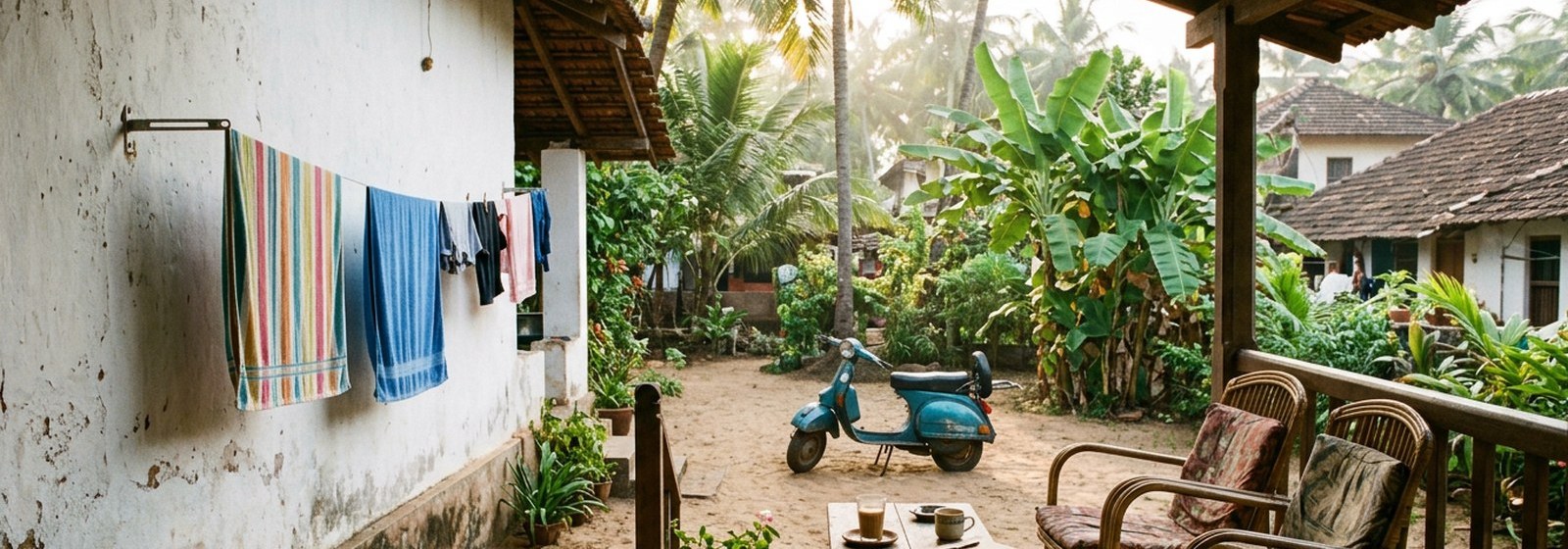
Wintering in India 2026–2027: where to live, what housing and food cost, flights, transfers and the visa
In winter India changes character: from October to March it's the dry season, the sea is warm, there's almost no rain, and places are rented by the month rather than by the night. Wintering here isn't a two-week holiday but a second home for the season: from December to February it's comfortable both on the beach and on day trips.
We break wintering down by money and by practicalities: where it's genuinely good from December to February, what housing and food cost for a month, how long the flight takes and how to get out of the airport, what's happening with the visa this season, and which mistakes cost the most.
A couple for 30 days without flights, visa or insurance — ₹61,700–109,000; per person with shared accommodation — ₹30,850–54,500. Housing for a month — from ₹15,000, thali — ₹140–300, a scooter — from ₹8,000 a month. Rate on 24 September 2026: ₹1 ≈ €0,0092, €1 ≈ €1.
What wintering costs: benchmark prices for a month
The prices below are in rupees, converted at the rate of 24 September 2026 (₹1 ≈ €0,0092). These are living costs, without flights, visa or insurance.
- Housing (studio or 1 RK for 30 days) — ₹15,000–25,000 ≈ €137–229
- Food: groceries plus inexpensive cafés for two — ₹24,000–36,000 ≈ €220–329
- Scooter and fuel — ₹10,000–20,000 ≈ €92–183
- Phone and internet — ₹700–1,000 ≈ €6–9
- Total for a couple for 30 days — ₹61,700–109,000 ≈ €564–998
- Per person with shared accommodation and one scooter — ₹30,850–54,500 ≈ €282–499
- A family of two adults and a child — ₹76,500–139,000 ≈ €700–1 270
The most expensive dates of the season are late December and the first week of January: accommodation rates rise then, and it's better to agree on them in advance.
The climate: where winter means +32 and where it's +1 at night
Below is actual data for December–February of the 2025/26 season, not general talk about 'warm India'.
- Goa: around +32 by day, +22 at night, three millimetres of rain over three months and not a single rainy day
- Kerala (Kochi): +32 by day, +24 at night, but about 21 rainy days and 90 mm of rain over the season
- Delhi: +22 by day, +11 at night, some mornings down to +5 and frequent fog — you need a jacket
- Varanasi: +23 by day, +12 at night
- Rishikesh: +21 by day, +6 at night, sometimes +1; Dharamsala: +14 by day, +8 at night, occasionally zero
The simple logic of the season: for a beach winter it's Goa, Kerala, Karnataka and Tamil Nadu; for sightseeing it's Delhi, Rajasthan and Varanasi; the Himalayas are cheaper and emptier in winter, but that's cold, not beach.
Where to winter: the main places
North Goa — Arambol, Morjim, Ashwem, Anjuna, Vagator
The cheapest and most social option. Arambol has plenty of long-stayers, yoga studios, music and inexpensive cafés. Morjim is calmer and more often chosen by families, Ashwem is quieter and roomier but awkward without a scooter. Anjuna and Vagator are livelier and pricier.
South Goa — Palolem, Agonda, Benaulim, Canacona
Less density and bustle, more greenery. Two-bedroom places start from ₹25,000–30,000 for 30 days (in Canacona — from ₹30,000). The downside: some services and kids' activities take longer to find, and the state capital is further away.
Kerala — Varkala, Kovalam, Munnar, Alleppey
Ayurveda, backwaters, tea plantations, houseboats. A one-bedroom flat outside central Kochi costs about ₹9,700 a month (range ₹7,000–11,400) — noticeably cheaper than Goa. The price you pay is humidity and short showers in December.
The Himalayas — Dharamsala, Rishikesh, Manali
Yoga, treks, cheap housing and food. It's cool in winter, some guesthouses have no heating, but prices fall and there's hardly anyone around.
Rajasthan and the Golden Triangle — Delhi, Agra, Jaipur, Udaipur, Jodhpur
The best season for sightseeing: not hot, you can see the monuments without wilting. Living for a month is cheaper than Goa, but there's no beach — this is an urban winter.
Hampi and Gokarna
Between Goa and Kerala: rocks, ruins, palms, small guesthouses. Less infrastructure for long stays, but for a month or two it's just right.
Housing: prices and how to rent the right way
- Studio or 1 RK for 30 days — ₹15,000–25,000. September 2026 listings included options around ₹15,000 in Porvorim, ₹18,000 in Arambol and ₹25,000 in Vagator — those are specific offers, not the state average
- A one- or two-bedroom flat for a family — ₹25,000–45,000 for 30 days
- A one-bedroom outside central Panaji — about ₹12,700 (range ₹10,000–18,000)
- The deposit is usually one month's rate, and electricity is often paid separately
What to do so you don't lose money
- Book the first 3–7 nights in advance, then look for the long-term option once you're there
- Don't wire a large advance to a stranger based on messages alone
- Before paying, come back to the property in the evening and listen to the noise, and test the Wi-Fi in the exact room where you'll work
- Film the furniture and appliances, and note the meter reading when you move in
- Ask straight away what's included in the price and whether the rate changes over New Year
- Check corners and cupboards for mould: humidity here does things no photo shows
Food and groceries: what it costs in rupees
- Lunch at an inexpensive restaurant — ₹250 (range ₹150–500)
- A simple thali — ₹140–300, a fish thali — ₹180–400 and up
- Dinner for two at a mid-range restaurant — around ₹1,500
- Breakfast of idli and dosa at a local café — ₹95–170, at a tourist café — ₹300–600
- Groceries at the Panaji market: milk 1 L — ₹68, bread 500 g — ₹45, rice 1 kg — ₹74, eggs 12 — ₹87, chicken 1 kg — ₹334, bananas 1 kg — ₹80, tomatoes 1 kg — ₹39, potatoes — ₹37, onions — ₹41, water 1.5 L — ₹34
Groceries plus inexpensive cafés for two — ₹24,000–36,000 a month. The cheapest food is where locals eat: canteens away from the seafront, thalis, fish from the market and cooking at home. The priciest are tourist-café breakfasts, imported groceries and alcohol.
Flights: what a winter ticket costs
Winter is high season in Goa: charters and scheduled flights from Europe, the Gulf and Southeast Asia fill up from mid-December to mid-January, and fares peak with them. Booking 6–10 weeks ahead, or shifting your dates a week either side of the holidays, usually saves the most.
What the ticket search showed on 24 September 2026 (one way, October departures, cheapest fares):
- Berlin — Goa from €250, Amsterdam — Goa from €306, Madrid — Goa from €321, Rome — Goa from €294, London — Goa from €360, Warsaw — Goa from €314
- Amsterdam and Berlin are usually the cheapest European gateways to Goa; one stop via Istanbul, Dubai or Doha is the norm
- inside India: Delhi — Goa and Mumbai — Goa are short hops, often under €40 — flying into a hub and connecting is often cheaper than a direct flight
- domestic Indian carriers (IndiGo, Air India Express) are cheapest when booked 4–8 weeks ahead
Compare prices from your own city before you commit: a one-stop route is often cheaper than a direct one, and winter fares move every week.
Transfers: how to get from the airport
Goa has two airports: Dabolim (GOI) in the south of the state and Mopa (Manohar, GOX) in the north. Dabolim is about two hours from the northern beaches; Mopa is closer to Arambol, Morjim and Ashwem — pick the airport that matches where you're staying.
Benchmarks for a pre-booked online transfer from Dabolim (fixed price, meet-and-greet with a name sign, data from May 2026): Calangute, Candolim, Baga, Arpora — €28, Anjuna and Vagator — €30, Ashwem — €34, Mandrem — €38, Arambol — €39.
Alternatives on the ground: the prepaid taxi desk in the arrivals hall, where the price is fixed by the state tariff before the trip, and the GoaMiles app. Taxis in India almost never have meters, so it's best to agree the price before you get into the car.
The visa: what changed in 2026
From 1 January 2026 India waived the consular fee for the 30-day electronic tourist visa for a number of nationalities. Fees and eligibility depend on your passport, so check the current rules for your country on the official portal before you pay anyone.
- the 30-day e-Tourist visa gives 30 days from first entry — not enough for the season
- the one-year visa (fee around $40) is valid for 365 days from issue, the five-year one (from $80) — for five years
- on the one- and five-year tourist visas, total stay in India must not exceed 180 days in a calendar year: wintering from October to March is roughly 150 days, so it fits the limit
- an e-Visa can't be extended inside the country, nor converted to another type: only exit and re-entry
How to apply: online on the official portal indianvisaonline.gov.in. Processing usually takes 3–5 working days, so it's best to apply 7–10 days before departure. The visa takes effect the day after issue, and you must enter on it within 120 days. Your passport must be valid for at least 6 more months and have two blank pages; a JPEG photo from 10 to 300 KB on a white background.
One separate point many people miss: 72 hours before arrival you need to fill in an electronic arrival card (e-Arrival card) — also on the portal indianvisaonline.gov.in. It isn't a visa but a notice of entry. You can enter on an e-Visa at roughly 30 airports, including Dabolim and Mopa; at land borders it generally doesn't apply.
And the main thing: a six-month lease doesn't extend your visa. First check how many days you're allowed in the country, and only then commit to housing for the whole season.
Money, connectivity and transport: the practical side
Money
Cards are accepted in hotels, large shops and chain cafés in the cities, but smaller places, markets and taxis are cash-only. ATMs are common, though foreign-card fees and per-transaction limits vary — check what your own bank charges abroad and carry a second card as backup.
Cash is the reliable fallback: bring clean, unmarked dollars or euros, change a small amount at the airport for the first day and the rest in town or at a bank. Break large notes early, because a rickshaw driver often has no change. Rupees can't be brought in or taken out in noticeable amounts, so you build your cash up locally.
Connectivity
A local SIM is registered with your passport and an address, and activation takes anywhere from a few hours to a day. 2026 rates: Jio — ₹349 for 28 days with 2 GB a day, Airtel — ₹349 for 28 days with 1.5 GB a day. Home internet costs ₹650–800 a month. If you'd rather not visit a shop with documents, get an eSIM in advance.
Transport
A scooter is a winterer's main transport: from ₹400 a day, from ₹8,000 a month when rented monthly and up to ₹20,000 and more depending on the model and season, with fuel around ₹101 a litre. Before paying, check the brakes, tyres, lights, whether helmets are included, the size of the deposit and the terms of liability for damage, and ask about driving-document requirements in advance: both the police and the insurer check them. Taxis are easiest to call via the GoaMiles app, and Kadamba Transport buses are the cheapest option, with a city ticket around ₹15.
What to see over the wintering season
While you're living in India for a month or two, it makes sense to book excursions with local guides rather than overpaying an operator: in Goa that's spice plantations, waterfalls, night markets and dolphins, in Kerala houseboats and tea plantations, in Rajasthan forts and the desert. Winter is also a good time to tick off the Golden Triangle: Delhi, Agra with the Taj Mahal, and Jaipur.
Three mistakes that cost the most
- Paying for 3–6 months of housing up front based on photos sent in a chat. First 3–7 nights, then a viewing, and only then a long lease
- Arriving with only a card and no cash. Dollars or euros plus a second card is the setup that works; 'I'll figure it out on the spot' doesn't work here
- Confusing the length of your lease with the length of your visa. A one-year tourist e-Visa allows no more than 180 days in total per calendar year, and your landlord doesn't override those rules
Pre-departure checklist
- Passport valid for at least 6 more months, with two blank pages
- e-Visa applied for 7–10 days before departure, printout or PDF with you
- e-Arrival card filled in 72 hours before arrival
- Cash dollars or euros plus a foreign bank card
- Insurance covering scooter injuries — that's a separate clause in the policy, check the exclusions
- First 3–7 nights of accommodation booked, the rest found on the ground
- Connectivity: eSIM before departure or a passport for a local SIM
- First-aid kit, mosquito repellent, bottled water only
Wintering in India is a second home for the season. If you do the maths in advance and don't book blindly, a month by the ocean comes out cheaper than a month of winter rent and heating back home.
FAQ
How much does wintering in India cost per month?
A couple spends ₹61,700–109,000 over 30 days without flights, visa or insurance: housing ₹15,000–25,000, food ₹24,000–36,000, scooter ₹10,000–20,000, connectivity ₹700–1,000. Per person with shared accommodation and one scooter — ₹30,850–54,500.
Where in India is it warm in winter and where isn't it?
A beach winter means Goa (+32 by day, +22 at night, almost no rain), Kerala, Karnataka and Tamil Nadu. Delhi in winter is +22 by day and +11 at night, and in the mountains (Rishikesh, Dharamsala) it can be near zero at night: there you need a heater, not air conditioning.
How much does renting a place for a month cost?
A studio or 1 RK in Goa — ₹15,000–25,000 for 30 days, a one- or two-bedroom flat — ₹25,000–45,000, a one-bedroom outside central Kochi — about ₹9,700. The deposit is usually one month's rate, and electricity is often separate.
What's the situation with the India visa in 2026?
For wintering you need the one-year (around $40) or five-year (from $80) visa: in total they allow no more than 180 days in India per calendar year. An e-Visa can't be extended inside the country.
Do I need an e-Arrival card?
Yes, 72 hours before arrival you fill in the electronic arrival card on the portal indianvisaonline.gov.in. It isn't a visa but a notice of entry; without it you'll get questions at the border.
How much is a flight to India?
Fares searched on 24 September 2026 (one way, October departures): Berlin — Goa from €250, Amsterdam — Goa from €306, Madrid — Goa from €321, Rome — Goa from €294, London — Goa from €360. Inside India, Delhi — Goa and Mumbai — Goa are often under €40. Always compare from your own city: a one-stop route is usually cheaper than a direct one.
How do I pay in India?
Cards work in hotels and larger venues, but markets, small cafés and taxis are cash-only. Bring clean dollars or euros plus a second card as backup, and check your bank's foreign transaction fees before you travel. Small notes matter: change is often scarce.
Do I need a licence and a helmet for a scooter?
A helmet is mandatory, and driving-document requirements are checked by both the police and the insurer — clarify them before renting. Monthly rental starts from ₹8,000, fuel around ₹101 a litre. It's best not to leave your passport as security.