
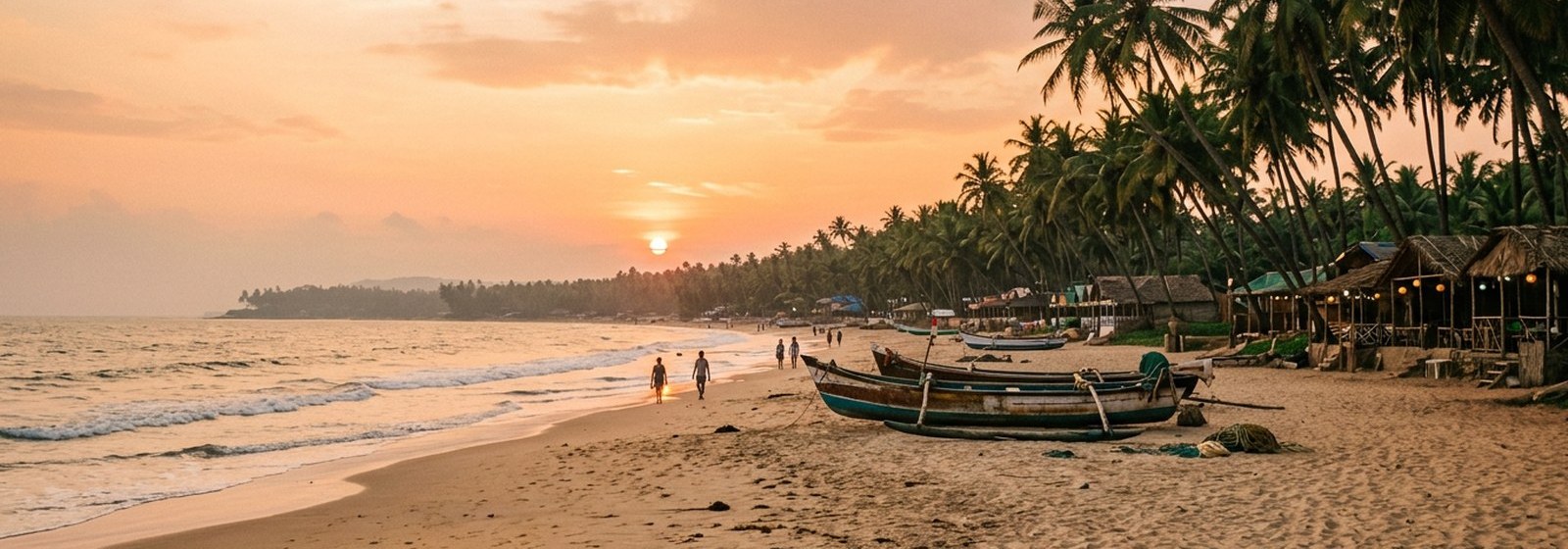
North Goa in winter: beaches, prices for housing and food, hotels and sights
From November to February, North Goa turns from a resort into a place to live: dry season, sea around +27°C, daytime +31…+33°C without draining humidity, warm nights and almost no rain for three months. These are the months when people come not for a week but for a month or longer — for the beaches from Calangute to Kerim, cafés right in the palms, busy markets and a calm, inexpensive life by the ocean.
We break it down by money and by substance: flights, housing, food, where to stay, what to see and how to spend your first days.
Prices are guide figures for the 2026–2027 season, in rupees (₹) and euros at roughly €1 ≈ ₹100.
A couple's monthly costs without flights, visa and insurance come to ₹60,000–110,000 (€600–1,100), with return flights from European hubs from €516. A studio 10 minutes from the beach starts at ₹20,000 (€200), food per person is ₹800–1,500 (€8–15) a day, a scooter is ₹6,000–10,000 a month.
What winter North Goa costs: guide prices
- Return flights from European hubs — €500–700
- A month's rent for a studio 10 minutes from the beach — ₹20,000–45,000 ≈ €200–450
- A night in a guesthouse or mid-range hotel — ₹1,000–7,000 ≈ €10–70
- Food per person without extravagance — ₹800–1,500 ≈ €8–15 a day
- Scooter — ₹300–500 a day ≈ €3–5, or ₹6,000–10,000 a month
- Taxi from Mopa airport — ₹1,200–1,800, from Dabolim — ₹900–1,500
- A couple for a month without flights, visa and insurance — ₹60,000–110,000 ≈ €600–1,100
Why winter: weather and sea
November is the season warming up: the air is +32°C, the water still holds its warmth, and prices are a third lower than in December. December and January bring dry, clear days, the most reliable swimming season and the peak of tourists, especially between 20 December and 10 January. February is the comfortable golden mean: the heat hasn't arrived yet and there are fewer people. From March, temperature and humidity climb and a beach wintering gradually fades. Goa is one of the few regions of India where in winter you need neither a sweater nor air conditioning at night.
How much a flight to Goa costs
The main winter hack — Goa has two airports. Dabolim (code GOI) lies in the central part of the state, Mopa (GOX) is in the far north, closest to Arambol, Morjim and Vagator. In winter, international flights increasingly land at Mopa, and from there the northern beaches are 40–60 minutes away instead of two hours.
Minimum flight prices to Goa from European hubs (return, in euros), according to Travelpayouts as of 5 October 2026:
- Berlin — from €516
- Warsaw — from €553
- London — from €554
- Amsterdam — from €580
- Lisbon — from €581
- Prague — from €599
- Paris — from €643
- Barcelona — from €644
- Vienna — from €653
- Madrid — from €696
These are the minimums for the current dates — the price depends heavily on the day of departure. The cheapest tickets for a winter stay are found in late November and the first two weeks of December; rates rise toward the Christmas holidays and fall again from mid-January.
Getting there and the visa
Most travellers reach North Goa by flying into Mopa (GOX) with one stop from a European hub; the GOX and GOI airports were covered above. The cheapest dates for a winter stay are late November and early December, before the Christmas rush pushes fares up.
The visa is arranged online, quickly and cheaply. The Indian e-Tourist visa is issued through the official portal indianvisaonline.gov.in: you fill in the form, upload a photo and a scan of your passport, and pay by card — no separate visa centre is needed. The cost is about US$25 plus a bank fee, with a decision usually within 3–7 business days. The visa is tied to your passport and arrives by email — printing it isn't required, showing it on your phone is enough. Check the current conditions and fees for your own nationality on the official portal.
Housing: a month by the sea and a night in a hotel
North Goa means guesthouses, family-run mini-hotels and apartments rented by the month. Long-term rental for 25–30 days works out several times cheaper than nightly bookings. Live guide figures for the season:
- Night: a hostel or simple room — ₹500–1,000; a budget guesthouse — ₹1,000–2,000; a mid-range hotel with a pool — ₹3,000–7,000; a premium resort — ₹15,000–50,000
- Month: a studio or 1 BHK 10–15 minutes from the sea — ₹20,000–45,000. Cheapest in Arambol and Morjim (from ₹20,000), pricier in Anjuna, Vagator and Calangute (₹30,000–50,000)
A tip on method: don't book the whole month in advance at a high rate. Take a guesthouse for 3–4 nights, then look at 4–5 options on the ground and agree a monthly price directly with the owner — that saves up to half.
Food: how much goes on groceries and cafés
Goan cuisine is fish, coconut, rice and spices. A fish curry rice lunch at a local place costs ₹60–150, a thali in a tourist café — ₹150–300, street food (samosa, pav bhaji, dosa) — ₹50–100. Dinner for two in a decent restaurant — ₹1,200–2,500, beer — ₹100–200 a bottle, local feni — ₹100–150, coconut water from a beach stall — ₹40–60. Groceries at the Mapusa market or the Friday bazaar will cost noticeably less than cafés.
The daily budget per person works out like this: frugally, cooking at home and eating at local spots — ₹800–1,200; comfortably, with cafés and fish a couple of times a day — ₹1,500–2,500. A couple who has breakfast at home and lunch at a shack easily stays within €20 a day for two.
The coastal towns of North Goa — from south to north
- Calangute — the widest and most developed strip, with plenty of shops, shacks and water sports. A convenient base for a first trip, but the busiest and noisiest.
- Baga — a continuation of Calangute, in the evening the centre of nightlife (Tito's Lane). By day it's calmer than its reputation suggests.
- Candolim — three kilometres of sand a little calmer than its neighbours, an even entry into the water, lots of families. Fort Aguada is nearby.
- Sinquerim — a quiet, rocky stretch right by the fort, good for a relaxed day.
- Anjuna — a rocky headland, cliff-top cafés, the cult Wednesday morning market. A young, alternative crowd.
- Vagator — red laterite cliffs, the best sunset spots and Chapora Fort on the hill.
- Chapora — a fishing village at the river mouth, a ferry to the other bank, a thoroughly untouristy rhythm.
- Morjim — calmer and greener, popular with families and long-stayers; in winter sea turtles nest on the beach.
- Ashwem — a wide, quiet beach without fuss, a favourite of winterers from Europe.
- Mandrem — almost empty sands and cafés on the water, a gentle entry into the sea.
- Arambol — the most democratic and long-lasting: yoga, music, cheap guesthouses, a freshwater lake with a hot spring nearby.
- Kerim (Querim) — the last beach on the border with Maharashtra, silence, a ferry and almost no people.
Hotels: from guesthouse to resort
Hostels and guest houses — ₹500–1,000 for a bunk and ₹1,000–2,500 for a room; mid-range hotels with a pool and breakfast — ₹3,000–7,000; design and premium resorts — from ₹15,000 a night, while flagships like W Goa in Vagator go past ₹50,000. For a long stay, many choose not the coast but the villages inland — Assagao, Siolim, Parra: quieter, cheaper, 10–15 minutes by scooter to the sea. Flagship hotels for the Christmas dates should be booked months ahead: the markup from 20 December to 10 January reaches up to three times the normal rate.
What to see in North Goa
Ready-made tours — forts, Old Goa, spice plantations, Dudhsagar — are convenient to see and book in advance.
- Chapora Fort — laterite walls on a hill above Vagator and the river mouth, a panorama of the coast and the best sunset. Free entry; best to arrive by 17:00.
- Fort Aguada and the lighthouse — a 17th-century Portuguese fortress above Sinquerim, next to the Sea-Behind Aguada viewpoint with a view of the sea and the Mandovi estuary.
- Reis Magos Fort — a neatly restored fortress above the Mandovi river, a calm and uncrowded place.
- Old Goa — a UNESCO site: the Basilica of Bom Jesus and the Cathedral of St Catherine, free entry.
- Fontainhas in Panaji — a colourful Latin quarter with coloured houses and old Portuguese façades, ideal for a walk.
- Spice plantations — cardamom, pepper and cinnamon in the open air, a tour with a Goan lunch ₹400–600.
- Dudhsagar — a waterfall in the jungle, reached by jeep safari (₹2,500–3,500 per group), best in the early season.
- Salim Ali Bird Sanctuary — a mangrove bird reserve on Chorao Island, entry plus boat.
- Anjuna market (Wednesday) and Arpora night market (Saturday) — clothes, crafts, live music; free entry, bargain from half the asking price.
- Mapusa market (Friday) — a local bazaar with spices, fruit and everyday Goan life.
- Turtle Beach in Morjim — from November to March olive ridley turtles lay their eggs here.
An itinerary for your first 3 days
- Day 1. Check in at Candolim or Calangute, an easy start after the journey: lunch at a shack, a swim, in the evening a climb to Fort Aguada for sunset and a fish dinner.
- Day 2. A beach day: Baga and water sports in the morning, in the afternoon move on to the Vagator cliffs, in the evening Chapora Fort and a café on the cliff.
- Day 3. A cultural outing: Old Goa with the basilica and cathedral, a walk around Fontainhas in Panaji, with a spice plantation and lunch along the way; if it's a Wednesday, finish at the Anjuna market.
Three mistakes that cost the most
- Booking the whole month online in advance. The 30-day price 'head-on' on an aggregator is often higher than a monthly deal agreed on the ground; take 3–4 nights and search locally.
- Settling in Morjim or Ashwem without a scooter. Cafés, the market and the pharmacy are at a distance here, and tuk-tuks for short trips cost disproportionately. A scooter at ₹6,000–10,000 a month solves everything.
- Ignoring the Christmas markup. From 20 December to 10 January, housing gets several times more expensive; if you're coming for a winter stay, arrive before that window.
A checklist for wintering in North Goa
- A scooter with an international driving permit — right away or in the first days
- A local SIM card with internet — ₹200–300, or set up an eSIM in advance: https://yesim.app/?marker=138980
- Cash for the first while plus a card that works abroad
- Light clothing, SPF cream, mosquito repellent for the evening
- Medical insurance with coverage in India
- Copies of your passport and visa kept separately from the originals
Frequently asked questions
How much money do you need for a month in North Goa?
A couple spends ₹60,000–110,000 (€600–1,100) for 30 days without flights, visa and insurance. Inside: housing ₹20,000–45,000, food ₹24,000–45,000 for two, scooter ₹6,000–10,000, connectivity ₹200–300 per person.
When is the best time to go for a winter stay in Goa?
From November to February. November is about a third cheaper than December prices, December and January are the driest season and the peak of tourists, February is the comfortable golden mean. From March the heat and humidity grow.
Which Goa airport is closest to the northern beaches?
Mopa (GOX) — the closest: 40–60 minutes to Arambol, Morjim and Vagator. Dabolim (GOI) is in the centre of the state, about two hours from the north. A taxi from Mopa costs ₹1,200–1,800.
How much does a flight to Goa cost in winter?
From European hubs, return — €500–700 (Berlin from €516, Warsaw from €553, London from €554). The cheapest dates are late November and early December.
Do I need a visa for India and how much does it cost?
Yes. The Indian e-Tourist visa is arranged online on the official portal indianvisaonline.gov.in. The cost is about US$25 plus a bank fee, and the decision usually takes 3–7 business days. Check the current conditions and fees for your own nationality on the official portal.
How much does renting housing in North Goa cost per month?
A studio or 1 BHK 10–15 minutes from the sea — ₹20,000–45,000 a month. Cheapest in Arambol and Morjim (from ₹20,000), pricier in Anjuna, Vagator and Calangute (₹30,000–50,000). A guesthouse night is ₹500–7,000 depending on the class.
Do I need a scooter and how much does it cost?
For Morjim, Ashwem and Mandrem — yes: cafés, the market and the pharmacy are at a distance, and tuk-tuks for short trips are expensive. A scooter costs ₹300–500 a day, ₹6,000–10,000 a month. An international driving permit is required.
What is there to see in North Goa besides the beaches?
Chapora, Aguada and Reis Magos forts, the UNESCO site of Old Goa with the Basilica of Bom Jesus, the Latin quarter of Fontainhas in Panaji, spice plantations, Dudhsagar waterfall and the Salim Ali bird sanctuary. Many forts and temples have free entry.