
Tunisia: the known and the unknown — 18 places, 2026 prices and a 10-day itinerary
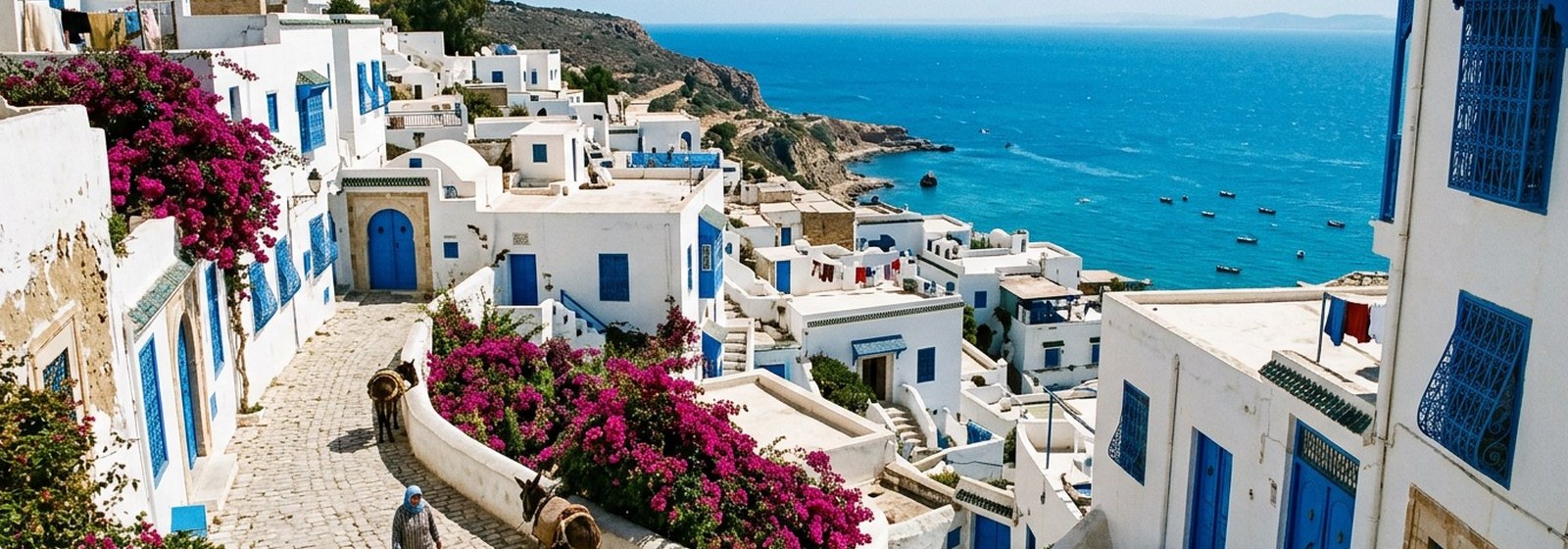
Tunisia is known for two images: a sandy beach with umbrellas and the white-and-blue streets of Sidi Bou Said. The real country is wider: in ten days you can stand among the columns of Roman baths on the shore, look at mosaics that are two thousand years old, climb down into a Berber underground house in Matmata and watch the sun set over the Sahara dunes near Douz.
We break Tunisia down into three layers: the “known” — 10 places that appear on every tour, the “unknown” — 8 ancient cities and Berber villages that tour buses never reach, and the practical side — real October 2026 prices, transport, visa and a 10-day itinerary.
A day in Tunisia without an all-inclusive hotel costs 40–80 TND per person: lunch at an inexpensive restaurant 12 TND, coffee 3.4 TND, a louage from Tunis to Sousse 12–13 TND, a city taxi 2–6 TND. Tickets to the main monuments under the 2026 tariff are 30 TND (Carthage, Kairouan, El Jem, the Bardo Museum), regional museums 10 TND. A flight Paris→Tunis for November 2026 starts at €82, London→Tunis at €90, Rome→Tunis at €85. Citizens of the EU, the UK and the US don't need a visa for stays of up to 90 days. Exchange rate on 5 October 2026: €1 ≈ 3.37 TND, 1 TND ≈ €0.30.
In short: three Tunisias in one country
Tunisia is the smallest country in the Maghreb: 163,610 km², about 1,300 km of Mediterranean coastline and only about 1,000 km from the green north to the sands of the Sahara. The Phoenicians founded Carthage here, Rome built the empire's third-largest amphitheatre, the Arabs built holy Kairouan, and the French protectorate left behind a habit of baguettes in the morning and bilingual road signs.
For a trip this means you don't have to choose between the beach and history: in the morning you stand among the columns of Roman baths on the shore, at midday you drink mint tea in Sidi Bou Said, and two days later you sleep beside the Chott el Jerid salt flat. Below are the three layers of the country and what it all costs in autumn 2026.
- 🏖️ Beach Tunisia — Hammamet, Sousse, Monastir, Mahdia and the island of Djerba: sand, thalassotherapy, all-inclusive hotels.
- 🏛️ Ancient Tunisia — Carthage, the Bardo Museum, El Jem, Dougga, Kerkouane: Roman mosaics, amphitheatres and Punic ports.
- 🏜️ Saharan Tunisia — Douz, Tozeur, Matmata, Chenini, Ksar Ghilane: dunes, oases, Berber villages and Star Wars sets.
What a trip costs: 2026 price benchmarks
All prices below are live benchmarks checked in early October 2026. The Tunisian dinar is a closed currency: you can't buy it abroad, taking cash dinars out of the country is forbidden, and the rate inside the country is state-regulated and almost the same at the airport, in banks and at exchange offices. Benchmark for 5 October 2026: €1 ≈ 3.37 TND, 1 TND ≈ €0.30.
- Flights: Paris→Tunis from €82 (20 Nov 2026), Rome→Tunis from €85, London→Tunis from €90 (26 Nov), Madrid→Tunis from €92 (19 Nov), Berlin→Tunis from €105 (15 Nov), Paris→Djerba from €88 (28 Nov) — Travelpayouts, November 2026.
- An all-inclusive package for a week for two in a 3* hotel is usually better value booked as a package together with flights.
- Budget hotels: from €35 per night in Hammamet, from €40 per night on Djerba.
- Lunch at an inexpensive restaurant — 12 TND, dinner for two at a mid-range restaurant — 67.5 TND, coffee — 3.4 TND, 0.33 l water — 1.15 TND.
- Louage (shared minivan): Tunis–Hammamet 7–9 TND, Tunis–Sousse 12–13 TND, Tunis–Kairouan 14–16 TND, Gabès–Djerba 10–14 TND.
- City taxi — 2–6 TND, from Tunis airport to the centre — 15–30 TND, after 21:00 the fare is about one and a half times higher.
- Car rental — 85–140 TND per day, petrol — 2.52 TND per litre, a domestic flight Tunis–Djerba — 80–180 TND.
- Daily budget without accommodation — 40–80 TND per person if you stay in guesthouses and eat at local places.
Known Tunisia: 10 places that appear on every tour
1. Carthage — capital of a vanished empire
The city was founded by the Phoenicians in 814 BC, and by the 3rd century BC it controlled the entire western Mediterranean — from Sicily to southern Spain. The Romans razed Carthage to the ground, then rebuilt it a century later. Today it's a hill with the columns of the Baths of Antoninus, a view over the bay from the second floor of the Roman baths and two round Punic ports where warships once stood. The ancient theatre was reconstructed in the 20th century and still hosts performances.
2. Sidi Bou Said — the white-and-blue town above the sea
18 km from the capital is that postcard image: white walls, blue shutters, wrought-iron lamps and bougainvillea spilling from balconies. In the 1920s this palette was made law so that no one could break the harmony. The town is named after the Sufi saint Abu Said al-Baji, who lived here in the 13th century; his tomb still sits at the top of the hill. People come for the shot from the cliff over the Gulf of Tunis — on a clear day you can see Carthage in the distance. A caveat: prices in local cafés are higher than in the capital, and mint tea can cost twice as much — you're paying for the scenery.
3. The Tunis medina and the Zitouna Mosque
The historic core of the 8th-century capital is a labyrinth of cobbled lanes, craft workshops, carved wooden doors and inner courtyards, a UNESCO site. The Zitouna Mosque (the “Mosque of the Olive”) is the spiritual heart of the medina and one of the oldest Islamic temples in North Africa; non-Muslims are admitted to the inner courtyard in the morning hours. The bazaars are divided by trade: Souk El Attarine for perfume and aromatic oils, Souk El Berka for jewellery, Souk El Chewachia for workshops making the wool chechia hats. In the carpet shops, sellers often let you onto the roof — from there you get the best view of the medina rooftops and minarets.
4. The Bardo National Museum
A former palace of the beys and the second-largest collection of mosaics in the world: thousands of square metres of Roman mosaics from the 2nd–5th centuries, taken from villas across North Africa. The main masterpiece is the 15-by-9-metre “Triumph of Neptune”, along with the only surviving life portrait of the poet Virgil with the Muses. Allow 2.5–3 hours for the museum and arrive at opening time, before the groups.
5. Hammamet — the country's first resort
Sandy beaches, eucalyptus, citrus groves and two centres: the old medina by the sea with its fort, and the new Yasmine Hammamet with all-inclusive hotels and thalassotherapy. A convenient base for trips: an hour to Tunis, two hours to Kairouan, two hours to El Jem. Enfidha airport, the nearest gateway, is about 40 minutes away.
6. Sousse — port, medina and ribats
The country's third-largest city and the main transport hub of the south: louages and trains leave from here for Kairouan, Sfax, Monastir and beyond. The medina is ringed by fortress walls; inside are the 9th-century Great Mosque and a ribat fortress with a view over the port. The beach in the centre is urban, but the sand is good and life is cheaper than in Hammamet.
7. Monastir — fortress town and Bourguiba's birthplace
A compact town with a huge 8th-century ribat fortress right on the shore: climb the walls and the whole Mediterranean coast lies before you. Here too are the mausoleum of Tunisia's first president, Habib Bourguiba, and an international airport. From Sousse you can get here on the Sahel Metro for 2–3 TND.
8. Kairouan — the holy city of the Maghreb
Founded in 670, it entered Islam's top four alongside Mecca, Medina and Jerusalem. The Great Mosque is one of the oldest in North Africa, and its 31-metre minaret became a model for the whole Maghreb. Nearby are the Aghlabid basins, two 9th-century reservoirs of 30,000 cubic metres each: in the desert this was a feat of engineering. Non-Muslims aren't admitted to the prayer hall, but the courtyard and minaret are open and photography is allowed.
9. El Jem — the African Colosseum
A 3rd-century amphitheatre for 35,000 spectators in the centre of the country: the Roman Colosseum is bigger, but the Tunisian one is better preserved — the outer walls, tiers and underground passages are all in place. The chambers beneath the arena, where gladiators and animals were held and hoisted up through trapdoors, are especially impressive. It's stuffy inside in summer, so come at opening time at 8 am.
10. Djerba — the island of white houses and crafts
The largest island in North Africa, joined to the mainland by a 7-km causeway. Here are the El Ghriba synagogue, considered one of the oldest in the world (probably 6th century BC) and a destination for pilgrims every May; the pottery town of Guellala; the market in Houmt Souk; and the best beaches of the south-east — Ségia and Aghir. A separate plus is its own airport, which makes Djerba easy to reach by direct flights.
Unknown Tunisia: 8 places tour buses don't reach
1. Dougga — a Roman city among the hills
100 km from the capital, at an altitude of 550 metres, is one of the best-preserved Roman cities in Africa and a UNESCO site. Unlike Carthage, there are no modern layers here: a 3,500-seat theatre with perfect acoustics, the Temple of Jupiter on the summit and a view over the valley for tens of kilometres. The city was abandoned in the 7th century, and the earth covered it for nearly a thousand years — and preserved it.
2. Bulla Regia — the “royal town”
An ancient city in the north-west, known for the underground floors of its houses: in the heat the Romans lived below, not above. Mosaics in situ, and almost no tourists. It's easiest to reach by rented car or with a taxi driver arranged for half a day.
3. Kerkouane — the Punic city they never rebuilt
The only known Punic city that the Romans destroyed and never rebuilt — which is why it preserves the layout of pre-Roman Carthage. A UNESCO site on Cape Bon, near the beaches of Kelibia.
4. Ichkeul National Park
A marshy lake in the north, a UNESCO site and a wintering ground for hundreds of thousands of migratory birds: ducks, geese and flamingos stop here. The park is listed both as a natural and as a cultural site — nearby are the ruins of Utica. You'll need transport and half a day.
5. Matmata — the Berbers' underground world
In the south the Berbers for centuries didn't build houses on the surface but dug them into the soft limestone: a courtyard with rooms around it, and about +20 °C inside all year round. Hotel Sidi Driss is the very home of the Lars family from Star Wars, and you can still stay the night there. Nearby are Ong Jemal (Mos Espa) and Ksar Haddada (the palace of Bib Fortuna). Public transport barely reaches here: you'll need a car or a tour.
6. Chenini and Douiret — Berber ksars
Genuine fortified granaries — ksars — and cliffside inhabited villages in the Tataouine area, where tour buses rarely go. From Douz you can get here by louage or hire a car with a driver for a day. The sunset over the stone ridges here is one of the best in the country.
7. Ksar Ghilane — an oasis with a hot spring
An oasis on the edge of the Grand Erg Oriental, where people come for the dunes and a warm spring in the middle of the sand: you can swim under the palms with nothing but dunes around. It's a drive from Douz along a desert road, best by 4x4 or on an organised trip; in 2026 stargazing camps are also set up here.
8. Chott el Jerid, Tozeur and Douz
Chott el Jerid is a salt flat of about 7,000 km² where the Tatooine salt flats of Star Wars were filmed: in summer the surface dries out and bakes above +50 °C, while in winter pink flamingos fly in. Nearby is Tozeur, a town of oases with palm groves, waterfalls in the oases and an old town. Douz is the “gateway to the Sahara”, where trips into the dunes set off. You can only walk on the salt flat where others have already gone: there's mud beneath the crust.
Tickets to the monuments: the new 2026 tariffs
Since April 2026, new state tariffs for museums and archaeological sites have been in force in Tunisia (a joint decree of the ministries of finance and culture dated 27 March 2026). The price depends on the category of the site, and it's worth factoring into your budget: a ticket to Carthage and the Bardo now costs as much as two lunches.
- Category A — the best-known sites: Carthage, Kairouan, El Jem, the Bardo Museum. From April 2026 — 30 TND (≈€9), from January 2027 — 45 TND.
- Category B — major ancient cities and monuments, including Dougga, Kerkouane and Bulla Regia. Benchmark — 20 TND (≈€6), from 2027 — 30 TND.
- Category C — regional museums of Sousse and Monastir: 10 TND.
- Category D — smaller sites: 8 TND.
- Category E — cultural and religious sites, including the Zitouna Museum and the museums of Douz and Gafsa: 5 TND.
- Combined ticket “Bardo + Carthage” — 45 TND, from 2027 — 70 TND. Tariffs are then indexed by roughly 5% a year.
- Tunisians and citizens of Maghreb countries pay less: 9 TND at Carthage, 8 TND at the Bardo and El Jem, 5 TND for C–D sites, 4 TND for category E. Locals enter free on Sundays, on public holidays, and on 18 April and 18 May.
- Children, students and pensioners — 2 TND or a 50% discount. It's best to pay in cash dinars.
Getting around: louage, trains and the TGM
The main transport between cities is the louage, a shared 8-seat minivan that departs once all the seats are sold. Louage stations exist in every town, the tariffs are fixed and posted up, and you pay in cash with small notes. Uber and Bolt don't operate in Tunisia, so taxis are hailed on the street and you ask for the meter (compteur) to be switched on.
- Louage: Tunis–Hammamet 7–9 TND, Tunis–Sousse 12–13 TND, Tunis–Kairouan 14–16 TND, Sousse–Monastir 4–6 TND, Gabès–Matmata 5–7 TND, Gabès–Djerba 10–14 TND.
- SNCFT trains on the Tunis–Sousse–Sfax line: Tunis–Sousse about 8 TND in second class (2 h 10 min – 2 h 30 min), Tunis–El Jem 10–11 TND, Tunis–Sfax about 12 TND.
- The TGM, a suburban line Tunis–La Goulette–Carthage–Sidi Bou Said–La Marsa: a ticket costs less than a cup of coffee (up to 1.5 TND), with trains every 10–20 minutes from early morning until midnight. The best way to do a “Carthage + Sidi Bou Said” day.
- The Sahel Metro links Sousse and Monastir for 2–3 TND.
- Taxis from Enfidha airport: to Hammamet 40–65 TND, to Sousse about 70 TND. Taxis from Tunis airport to the centre — 15–30 TND.
- Renting an economy car — 85–140 TND per day plus petrol at 2.52 TND per litre; for the south and Matmata this is the most convenient option.
Where to stay: resorts and cities
Your base determines the trip: from Hammamet and Sousse it's easy to take excursions across the north and centre, Djerba is a world of its own with beaches and crafts, and central Tunis is great for the ancient sights and the medina. All-inclusive is better value booked as a package with flights, while for independent travel ordinary hotels and guesthouses work well.
- Hammamet and Yasmine Hammamet — beaches, thalassotherapy, 3–5* hotels and proximity to Enfidha airport. Benchmark: budget options from €35 per night, mid-range from around €70.
- Sousse — cheaper and livelier, a transport hub for the south, with an urban beach and medina within walking distance.
- Djerba — an island for beach holidays: budget options from €40 per night, plenty of guesthouses in Houmt Souk.
- Central Tunis — for the Bardo Museum, the medina and TGM trips to Carthage and Sidi Bou Said; accommodation is pricier but the logistics are ideal.
- Mahdia and Monastir — quiet resorts between Sousse and Sfax for those who want fewer tourists and more local life.
- Douz and Tozeur — guesthouses and oasis hotels for the Saharan part of the route; in stargazing season places sell out early.
What to eat: from brik for a couple of dinars to tagine
Tunisian cuisine is a blend of Mediterranean, Arab and French: plenty of vegetables, olive oil, tuna, eggs and harissa. Street food is cheap and safe, though alcohol is sold only in limited places — in hotels and some restaurants.
- Brik — thin pastry with egg, tuna and parsley, deep-fried; one of the most recognisable snacks.
- Lablabi — a chickpea soup with garlic, cumin and harissa, the classic workers' breakfast.
- Couscous with lamb or fish — the Friday dish, with huge portions.
- Ojja — eggs stewed with tomatoes and peppers, often with merguez.
- Mint tea with pine nuts — the national drink, more expensive in tourist spots.
- Makroud — a semolina dessert with dates and honey, sold in the markets of Kairouan.
- Price benchmarks: lunch at an inexpensive restaurant 12 TND, dinner for two 67.5 TND, coffee 3.4 TND, water 1.15 TND, beer 5 TND, bread 1.13 TND, eggs (12) 5.33 TND, chicken 17.85 TND per kg.
Money, cards and exchange: what you need to know
The dinar is a closed currency, and half of Tunisia's money rules follow from exactly that. Cards are accepted in hotels and large restaurants, but markets, louages, taxis and the desert all need cash dinars.
- Exchange money in banks, at the airport or at exchange offices in hotels: the rate is state-set and almost the same everywhere.
- Keep your exchange receipts (bordereau de change) — without them the airport won't change leftover dinars back into foreign currency.
- Taking Tunisian dinars out of the country is against the law, and bringing in cash dinars isn't allowed either.
- Foreign currency equivalent to 20,000 TND or more must be declared at customs.
- Foreign Visa and Mastercard are usually accepted in hotels and large restaurants, but keep cash euros or dollars for markets, louages and taxis.
- At ATMs, withdraw dinars with a foreign bank card; the fee depends on the issuing bank.
- Tips aren't mandatory but are expected: 1–2 TND for a service or about 10% in a restaurant.
Connectivity and internet: SIM, eSIM and apps
Mobile service in Tunisia is cheap, and 4G coverage is good in Tunis, Sousse, Hammamet, on Djerba and along the whole tourist coast. 5G is only just appearing, so count on solid 4G.
- Three operators: Ooredoo, Orange Tunisia and Tunisie Telecom. Tourist SIM packages — a benchmark of 10–20 TND for 3.5–7 GB over 30 days.
- SIMs are sold at operators' shops and at the airport on presentation of a passport.
- If you'd rather not hunt for a shop, get an eSIM before you fly — your data turns on the moment you land.
- Uber and Bolt don't operate in the country; maps and an offline navigator come in handy for renting a car and for louages.
- Wi-Fi is available in hotels and cafés, but the speed is unstable — for work, a backup connection is better.
When to go: climate and sea by month
Tunisia has hot, dry summers and mild, rainy winters. On the Tunisian coast, August days average +33 °C and January +17 °C; annual rainfall is about 454 mm, the wettest month is February and the driest is July, when the sun shines for nearly 12 hours a day.
- July–August: +33…+37 °C, sea +26…+29 °C. Peak beach season; inland it's hot, and air conditioning is essential.
- September: +30…+33 °C, sea +25…+27 °C. Shoulder season — good both for the sea and for excursions.
- October: +25…+28 °C, sea +22…+24 °C. The most comfortable month for a “beach + history” route.
- April–June: +21…+29 °C, the sea gradually warms up, fewer tourists and lower prices.
- November–March: +17…+22 °C, cool evenings and rain, but this is the best time for the Sahara and the south — comfortable by day, chilly at night.
- For a trip with excursions and the desert, October–November and March–April are optimal.
Visa and entry for EU, UK and US travellers
For a tourist stay of up to 90 days, citizens of the EU, the UK and the US don't need a visa — neither in advance nor on arrival. The rules are simple, but a few details are worth knowing before you fly.
- You need a valid passport, and it must be valid for at least 3 months after the end of your trip.
- It's worth having a hotel booking or your accommodation address and a return ticket with you.
- The migration card is handed out on the plane or at the airport — keep the tear-off stub, it's asked for on departure.
- Medical insurance isn't mandatory, but it's recommended.
- Foreign currency equivalent to 20,000 TND or more must be declared; importing and exporting cash dinars is forbidden.
- Direct flights run to Monastir and Enfidha; connecting flights usually go via Istanbul, Cairo or Algiers.
- In 2027 a total solar eclipse will cross North Africa (2 August 2027) — hotels and transport for those dates are booked early.
A 10-day itinerary: beach + history + Sahara
The itinerary is built so you don't overspend on transfers: the first days are the capital and the ancient sights, then the coast, and the finale is the south and the Sahara. It can all be done by louage and train, but for Matmata and the desert it's easier to hire a car with a driver for two or three days.
- Day 1. Arrival in Tunis. The medina, the Zitouna Mosque, the bazaars, dinner in the centre.
- Day 2. TGM to Carthage and Sidi Bou Said, and the Bardo Museum in the evening.
- Day 3. Move to Hammamet or Sousse (louage 7–13 TND), beach and medina.
- Day 4. Sousse: the ribat, the Great Mosque, a walk around the port.
- Day 5. Monastir (Sahel Metro 2–3 TND) or a thalassotherapy day.
- Day 6. Kairouan: the Great Mosque, the Aghlabid basins, the makroud market.
- Day 7. El Jem: the amphitheatre and its underground chambers, then travel south in the evening.
- Day 8. Matmata: underground houses and the Star Wars sets.
- Day 9. Douz and Ksar Ghilane: dunes, the hot spring, a night in an oasis or at a camp under the stars.
- Day 10. Chott el Jerid and Tozeur, return or fly out of Djerba.
If you have less time, cut the south: a five-day version is Tunis, Carthage, Sidi Bou Said, Hammamet and Sousse. If you have more, add three days on Djerba with a flight from Tunis for 80–180 TND.
Mistakes that cost money, and a checklist
Most losses in Tunisia come not from scammers but from small things: the closed currency, the lack of change and not knowing the fixed tariffs. Here's what to keep in mind.
- Don't throw away your currency-exchange receipts — without them you can't change dinars back.
- Don't try to take dinars out of the country: they'll be confiscated at customs.
- Keep small notes: in louages and taxis “no change” is a common story.
- In taxis, ask for the meter; a negotiated price is almost always higher.
- Don't rely on cards everywhere — many places only take cash dinars.
- Don't plan the Sahara for July–August: the heat tops +40 °C and excursions move to sunrise.
- In mosques and old quarters cover your shoulders and knees; on the beach anything goes.
- In the medina keep your bags closed and don't carry large sums in one place.
- Checklist: passport, hotel booking, return ticket, cash euros or dollars, eSIM or SIM, sunscreen, a hat, modest clothing for mosques, swimwear, power bank.
Frequently asked questions about Tunisia
Do EU, UK or US citizens need a visa for Tunisia in 2026?
No. For a tourist stay of up to 90 days no visa is required. You need a valid passport (valid for at least 3 months after the end of your trip), a hotel booking and a return ticket. The migration card is filled in on the plane or at the airport; keep its tear-off stub until you leave.
How much does a flight to Tunisia cost?
According to Travelpayouts in early October 2026, for November 2026: Paris→Tunis from €82 (20 Nov), Rome→Tunis from €85, London→Tunis from €90 (26 Nov), Madrid→Tunis from €92 (19 Nov), Berlin→Tunis from €105 (15 Nov), Paris→Djerba from €88 (28 Nov). An all-inclusive package for a week for two in a 3* hotel is usually better value booked together with flights.
How much does entry to Carthage, the Bardo and El Jem cost?
Since April 2026 Carthage, Kairouan, El Jem and the Bardo Museum are category A and cost 30 TND (≈€9), rising to 45 TND from January 2027. Major ancient cities including Dougga and Kerkouane are a benchmark of 20 TND (≈€6). The regional museums of Sousse and Monastir are 10 TND, smaller sites 8 TND, and religious sites and the museums of Douz and Gafsa 5 TND. The combined “Bardo + Carthage” ticket is 45 TND.
How much does a day in Tunisia cost without an all-inclusive hotel?
A benchmark of 40–80 TND per person: lunch at an inexpensive restaurant 12 TND, coffee 3.4 TND, water 1.15 TND, beer 5 TND, a louage trip 7–16 TND, a city taxi 2–6 TND, a TGM ticket to Sidi Bou Said under 1.5 TND. The cheapest places to sleep are guesthouses and 3* hotels, while all-inclusive is better value as a package with flights.
Can you get around Tunisia without a car?
Yes. Louages — shared 8-seat minivans with fixed tariffs — run between cities (Tunis–Hammamet 7–9 TND, Tunis–Sousse 12–13 TND, Tunis–Kairouan 14–16 TND). Trains run on the Tunis–Sousse–Sfax line, the Sahel Metro links Sousse and Monastir for 2–3 TND, and Carthage and Sidi Bou Said are best seen on the TGM line. A car is only needed for Matmata, Chenini and the desert.
When is the best time to go to Tunisia?
For the beach, June to September, when the sea warms to +26…+29 °C. For a “beach + history” route the best months are October and November, with daytime temperatures of +25…+28 °C and no heat. For the Sahara and the south, November–March is more comfortable: warm by day, cold at night. December–February is the rainiest period on the coast.
What should you bring back from Tunisia?
Hand-painted ceramics from Nabeul, olive oil, jars of harissa, leather — handmade bags and belts for €20–30, mosaic panels and makroud from Kairouan. Haggling is appropriate in the markets and the medina, but it's easier to pay in cash dinars.
What's important to know about money in Tunisia?
The dinar is a closed currency: you can't buy it abroad, and taking cash dinars out of the country is forbidden, as is bringing them in. Keep cash euros or dollars and exchange them in banks and exchange offices. Always keep your exchange receipts (bordereau de change), otherwise leftover dinars won't be changed back. Currency equivalent to 20,000 TND or more must be declared.