
Antalya on a Budget: Top Sights, Prices and a 3-Day Itinerary
Antalya is not just all-inclusive resorts and beaches. It is a city where a Roman gate stands in the middle of ordinary apartment blocks, where one hilltop view takes in two bays at once, and where a couple of euros at the market buys you enough figs to stuff yourself. Around it there is a whole scatter of ancient cities, waterfalls and canyons that you can reach cheaply by bus.
The good news: everything worth seeing in Antalya can be done on a budget. The old town of Kaleiçi, the free beaches, the viewpoints, the parks and the markets cost almost nothing, and tickets to museums and ancient sites are pocket change compared with Europe. If you use public transport and eat at local hole-in-the-wall places (lokanta), a week in Antalya comes out cheaper than three days in Paris.
Below are all the main sights in Antalya and around it: from the centre out to the far day trips, with approximate prices and tips on how to save. Build the itinerary to suit yourself: even in three days you can genuinely see the old town, the waterfalls and the ancient theatres.
Antalya is not just all-inclusive resorts and beaches. It is a city where a Roman gate stands in the middle of ordinary apartment blocks, where one hilltop view takes in two bays at once, and where a couple of euros at the market buys you enough figs to stuff yourself. Around it there is a whole scatter of ancient cities, waterfalls and canyons that you can reach cheaply by bus.
What to see: the main sights
Kaleiçi
The historic heart of Antalya: narrow cobbled lanes, Ottoman houses with wooden bay windows, bougainvillea spilling across whole facades and cats on every wall. Hadrian's Gate, the Yivli Minare and the Old Harbour are all here too, so you can walk the entire old town in a single day. Tucked inside are small mosques, a medrese, souvenir shops and dozens of cafés in inner courtyards. Half the fun is simply getting lost and stumbling out at the sea.
Tickets: free (a walk) · 2–4 hours
Money-saving tip: Skip the paid guided tour of the old town — everything is within walking distance and signposted. Have breakfast in the side alleys away from the main street: the menus there are about a third cheaper.
Hadrian's Gate (Üçkapılar)
A white marble triumphal arch built to mark the Roman emperor Hadrian's visit in 130 AD. These are the only ancient gates of Antalya to survive almost intact: three passageways, columns and carved stonework. You literally walk through them from a noisy boulevard straight into quiet Kaleiçi, and the contrast is startling. It is the city's most recognisable landmark, and entry is free.
Tickets: free · 15–20 minutes
Money-saving tip: Come at opening time, around eight in the morning: no crowds in your photos and soft light. In the evening the gate is lit up — also beautiful, also free.
Yivli Minare
The symbol of Antalya: a fluted 13th-century Seljuk brick minaret that you can spot from almost anywhere in the centre. Next to it are a mosque with six domes and an old medrese that now houses a museum and souvenir shops. From the square you get a great view of the mountains and the rooftops of the old town. You can take in everything from outside in half an hour and without spending a single lira.
Tickets: free (mosque entry — outside prayer times) · 20–30 minutes
Money-saving tip: If you go inside the mosque, dress modestly and take off your shoes; women should cover their heads. It is free — just respect the rules and don't disturb those praying.
Old Harbour (Eski Liman)
Once a Roman and Ottoman harbour, now the most photogenic spot in Antalya: stone walls, a lighthouse, yachts and seagulls. Cafés and fish restaurants line the quay, and in the evening musicians play along the waterfront. Boats leave from here for the Düden waterfall and for short sea trips. Coming here, sitting on the parapet and watching the water is an evening in itself.
Tickets: free (boat trips — around €10–20, check locally) · 1–2 hours
Money-saving tip: For a boat trip, don't go to the first office you see — compare three or four kiosks along the quay: prices differ noticeably while the route is much the same. Haggling is normal here.
Konyaaltı Beach (Konyaaltı Plajı)
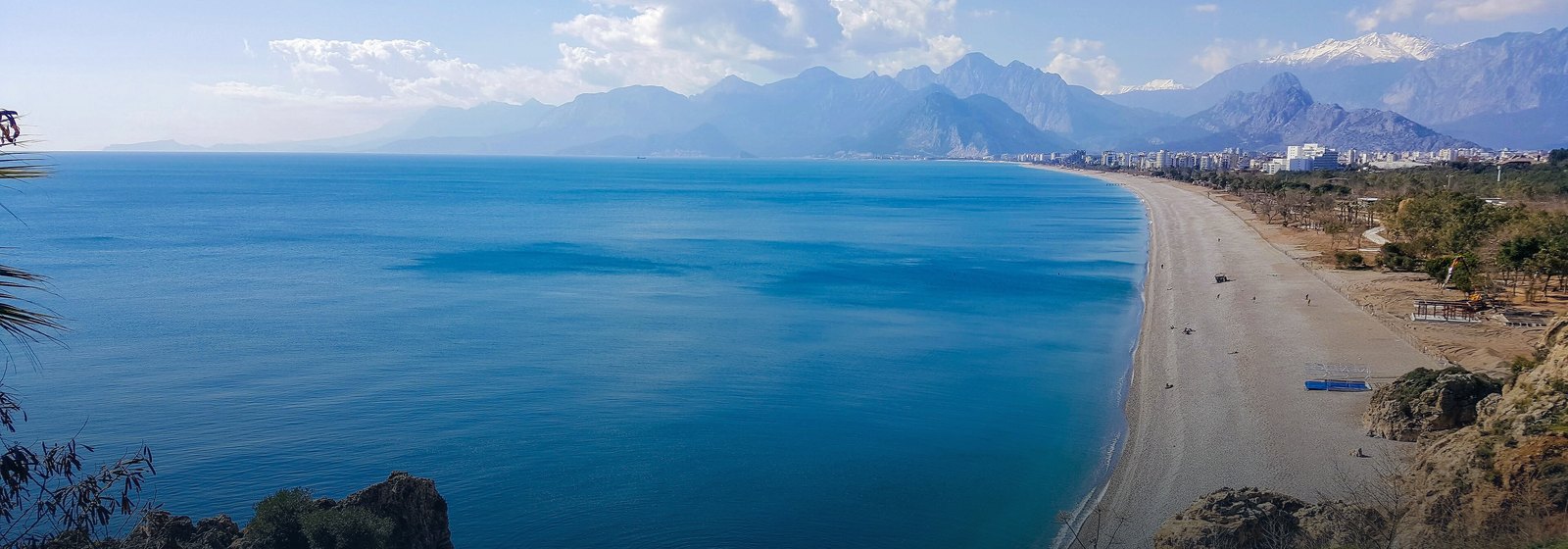
Antalya's main city beach: a long strip of pebbles and sand at the foot of the mountains, with clean water and an easy entry. The beach is free, and a park with paths, cafés and fountains runs alongside it. The sunset here is an attraction in itself: the sun drops right behind the Beydağları mountains. You can get here by tram or bus from the centre.
Tickets: free (sunbed and umbrella — around €5–10) · half a day
Money-saving tip: You don't need a sunbed — just spread your own towel on the free part of the beach. Buy food and water at a supermarket on the way: on the beach itself everything costs two or three times more.
Lara Beach (Lara Plajı)
A sandy beach on the eastern side of the city, more than ten kilometres long. Part of it is taken up by hotels, but there are always free public sections with entry and showers. The sand is soft and the water shelves gently — good with children and for long swims. You can get here by city bus, or by tram with a change.
Tickets: free (public sections; sunbed — around €5–10) · half a day
Money-saving tip: Head for the public section closer to the park area — there is no hotel supervision there and you can sit with your own umbrella. The sun here is fierce; sunscreen is a must.
Düden Waterfalls (Düden Şelalesi)
Lower Düden is the waterfall that plunges straight into the sea from a forty-metre cliff near Lara: thunder, spray and a rainbow on a sunny day. Upper Düden sits right inside the city, in a park, where you can walk behind the cascades through the grottoes. These are two different places, and both are worth a visit. In summer the water at the upper one is noticeably cooler than the air, which is a lifesaver in the heat.
Tickets: around €3–5, check the official site · 2–3 hours
Money-saving tip: See the waterfall from the sea on a boat trip from the Old Harbour — it is often cheaper than the paid viewing platform, and the view is better. If you go on your own, check the local bus timetable at the stop.
Kurşunlu Waterfall (Kurşunlu Şelalesi)
Unlike Düden, this is a quiet waterfall in the forest: several cascades, green grottoes, footpaths and ponds with ducks. The place feels more like a park than wild nature — perfect for a hot day. It is about 20 km from the centre, out towards the airport. There is a café and picnic shelters on site.
Tickets: around €2–4, check the official site · 2–3 hours
Money-saving tip: Bring a swimsuit: you can take a dip by the lower cascades. Come at opening time — later the tour buses arrive and it gets crowded.
Tünektepe Cable Car (Tünektepe Teleferik)
The cable car lifts you to the top of Tünektepe above Konyaaltı. From up there the whole of Antalya lies spread out below: two bays, the mountains and the sea to the horizon. There is a café and viewing terraces at the top, and you can just sit and look. It is the best panorama of the city for very little money.
Tickets: around €8–12 return, check the official site · 2–3 hours
Money-saving tip: Go for sunset, but check the time of the last descent — otherwise you will be walking down. In windy weather the cable car is sometimes closed, so don't leave it until your last day.
Antalya Museum (Antalya Müzesi)
One of Turkey's strongest archaeological museums: halls running from the Palaeolithic to the Ottoman Empire, statues of gods from Perge, sarcophagi and mosaics. There is a separate children's hall with interactive exhibits — a rarity in Turkey. After Perge and Aspendos the museum pulls everything you have seen into a coherent picture. It also displays finds that no longer stand at the ruins themselves.
Tickets: around €5–8, check the official site · 2–3 hours
Money-saving tip: Ask at the ticket desk about combined tickets: if you are also planning Perge and Aspendos, it may work out cheaper than buying them separately. Take the audio guide — without it the halls full of inscriptions make little sense.
Antalya Aquarium
A huge aquarium complex in Konyaaltı with the world's longest underwater tunnel and dozens of themed tanks. A good option for a day when the sea is rough or you want some cool air. There is a park and a beach nearby, so the day builds itself. Inside there is a tropical fish zone and a small ice attraction.
Tickets: around €15–25, check the official site · 2–3 hours
Money-saving tip: Buy your ticket online in advance — often cheaper and no queue. Only take the combined ticket if you will really visit every zone: bought separately it costs more, and on site you can easily change your mind.
Aspendos
An ancient city with the best-preserved Roman theatre in the world: it held fifteen thousand people and still hosts opera and ballet festivals. The acoustics are fantastic — from the top row you can hear a coin drop on the stage. Besides the theatre there is an aqueduct, a basilica and the ruins of the agora. This is arguably the region's premier ancient site.
Tickets: around €5–8, check the official site · 2–3 hours
Money-saving tip: Take a dolmuş from Antalya's bus station — many times cheaper than an organised tour. In summer an evening performance at the theatre costs more, but ordinary daytime entry is the standard price.
Perge
A large ancient city fifteen kilometres from Antalya: colonnaded streets, a stadium seating twelve thousand, an agora, Roman baths and a gate with Hellenistic towers. The apostle Paul once preached here, and that is part of the local story too. Many of the statues from Perge now stand in the Antalya Museum, so it makes sense to see the two one after the other. The site is big and pleasant to wander slowly.
Tickets: around €5–8, check the official site · 2–3 hours
Money-saving tip: Perge and Aspendos are easy to combine in one day: they lie in the same direction. There is almost no shade on site — bring water and a cap; the cafés there are few and expensive.
Side
A small town on a peninsula about an hour from Antalya, where ancient ruins stand right among residential streets. The Temple of Apollo by the sea, a huge amphitheatre, gates and colonnades — all right next to a sandy beach. Sunset at the Temple of Apollo is one of the most beautiful on the whole coast. On the way here you can stop at the Manavgat waterfall, it is very close.
Tickets: free entry to the site; individual monuments around €3–6 · half a day
Money-saving tip: Come under your own steam by bus and stay until evening: it is hot during the day, and in the evening the town empties out and is lit up. Have dinner in the side streets, not on the first row by the sea.
Kemer
A resort town forty kilometres from Antalya, squeezed between the mountains and the sea. A promenade, free beaches, pine-covered slopes and a cable car up Mount Olympos (Olympos Teleferik) with a view over the whole bay. From here Çıralı, Olympos and the Göynük canyon are within easy reach. It is a handy base if you want mountains and sea in one place.
Tickets: free; transport around €1–2 · a day
Money-saving tip: You can get here by city bus or dolmuş — many times cheaper than a tour. Accommodation in Kemer is cheaper than in Antalya out of season, so it is a good budget base.
Olympos and Çıralı (Olympos, Çıralı)
The ruins of ancient Olympos in a forest by the sea: a river, sarcophagi, a temple and tombs that you reach along wooden walkways. Next to it is Çıralı: a long sandy beach where caretta turtles lay their eggs. Here too is the eternal flame of Yanartaş (Chimera) — fire burning straight out of the rock. The place has real atmosphere and is nothing like the noisy resorts.
Tickets: Olympos entry around €2–4; Çıralı beach free · a day or an overnight stay
Money-saving tip: Stay the night at a pension in Çıralı — cheaper than the hotels in Kemer, and in the evening the beach is almost empty. Make the climb to Yanartaş in the evening when the heat has gone, and take a torch.
Demre and Myra (Demre, Myra)
The ancient city of Myra with rock-cut tombs carved into a sheer cliff face and a huge amphitheatre. Nearby is the church of St Nicholas — the original St Nicholas, whose bishop he was here. It is about two hours from Antalya, on the road towards Ölüdeniz and Fethiye. The rock tombs look as if they were carved yesterday: facades, columns and inscriptions cut straight into the stone.
Tickets: around €3–6 for the complex, check the official site · a day
Money-saving tip: Take a scheduled bus to Demre and walk from there — cheaper than a tour package. If you are travelling independently, combine it with Ölüdeniz or the Saklıkent canyon into one long day.
Alanya
A city east of Antalya with a fortress on the rock, the Red Tower and an old port. Cleopatra and Damlataş beaches offer sand and pebbles right beneath the fortress walls. From the top there is a view over the city, the sea and the Taurus mountains, and inside the fortress there are ancient cisterns and viewpoints. This is a full trip in its own right, not a quick look on the way.
Tickets: beach free; fortress around €2–5 · a day or an overnight stay
Money-saving tip: Buses run to Alanya, but it is a long way — better to go with an overnight stay than as a day trip. Climb up to the fortress early in the morning: by day the rock bakes mercilessly.
Free and off the beaten path
- Karaalioğlu Parkı — A big city park on the cliffs above the sea right in the centre: paths, palms, viewing terraces and a view over both bays. From here it is an easy walk to the Old Harbour and the beach. Free and open around the clock — a great spot for a picnic and a sunset.
- Hıdırlık Kulesi — An ancient tower on the rock between the two bays, free to enter. In the evening people come here to watch the sunset and listen to the sea. The terrace around the tower is one of the best free viewpoints in the city.
- Sarısu Plajı — A long free sandy beach away from the Lara hotels, with a shower and a café. Fine sand and a gentle entry, and there is always room. You can get here by city bus, and entry costs nothing.
- Konyaaltı Promenade — Many kilometres of seafront promenade: cycle lanes, outdoor gym equipment, cafés and free sections of beach. People rollerblade, run and simply stroll here until sunset. A perfect free evening by the sea.
- Antalya Atatürk Evi Müzesi — The house in Kaleiçi where Atatürk stayed, now a small museum with his personal belongings and early-20th-century interiors. Few visitors come, and it is a quiet corner two steps from the noisy main street. Entry is usually free — check on site.
3-day itinerary
Day 1
Morning — Kaleiçi: enter the old town through Hadrian's Gate, then the Yivli Minare and the crooked lanes lined with Ottoman houses. At midday head down to the Old Harbour, have tea on the quay and watch the boats. In the afternoon — Hıdırlık Kulesi and Karaalioğlu Park. In the evening — the Konyaaltı promenade and sunset by the mountains. Get around on foot plus the tram: from the centre to Konyaaltı costs a couple of lira.
Day 2
Start with the cable car up Tünektepe, while it is not yet hot and there are no queues — the whole of Antalya lies below you. Then a bus to the Antalya Museum: two or three hours among the ancient halls. In the afternoon — the lower Düden waterfall near Lara, and if you still have energy, the aquarium or Lara beach. Evening — dinner at a local lokanta away from the tourist centre.
Day 3
In the morning a bus to Perge: colonnaded streets and the stadium, an hour and a half to two hours. Then a dolmuş to Aspendos — the theatre that makes the trip worthwhile. After that, if you have time, Side with the Temple of Apollo on the shore and its evening sunset. Back to Antalya by scheduled bus; check tickets and timetables at the bus station (Otogar). If you would rather have sea and mountains than ruins, swap this day for Kemer and Çıralı.
Getting there
Antalya Airport (AYT) handles both scheduled flights and charters — prices drop in season (May–October). Tip: compare the airfare with a ready-made flight + hotel package — the package is often cheaper than the flight alone.
Food
- Lokantas — local canteens: a full lunch for €3–5
- Pide and gözleme (Turkish flatbreads) — filling and very cheap
- Markets instead of supermarkets — in-season fruit and vegetables are very cheap
Transport
Buy an AntalyaKart for trams and buses — the reloadable card covers all city transport, including the tram from the airport to the centre. Dolmuş minibuses run between districts — pay the driver in cash.
Where to stay
On a budget: guesthouses in Kaleiçi. For a beach holiday, price up an all-inclusive package in Lara — off-season it often beats paying for a room and restaurant food separately. Either way, compare prices with an aggregator.
FAQ
How much money do you need per day in Antalya?
On a budget, around €25–40 per person per day: a guesthouse or inexpensive hotel, food at local hole-in-the-wall places, transport and one or two paid attractions. If you stay in a hostel and cook some of your own meals, you can genuinely keep it to €20. Exact prices change — check on the spot.
When is the cheapest time to go?
May–June and September–October: the sea is still warm and prices are below the peak. July–August is the most expensive and hottest season. In winter Antalya is cool and rainy, but accommodation is at its cheapest and the sights are almost empty.
How do you get around the city cheaply?
Buses, the tram and dolmuşes: pay with an Antalya Kart or in cash to the driver, around €1–2 per ride — check the current fare locally. Taxis cost more. For longer trips take scheduled buses and dolmuşes rather than organised tours.
Do you have to go all-inclusive?
No. Antalya is full of budget hotels, guesthouses and apartments, and street food costs next to nothing. All-inclusive makes sense if you want to lie by the pool and go nowhere; for seeing the city and the surrounding area it is pointless.
Where can you eat cheaply?
Look for a sign saying 'lokanta' or 'ev yemekleri' — that is home cooking sold by weight, plus set lunches. Street food: gözleme, döner, balık ekmek, simit. At the markets (pazar) fruit and vegetables cost a fraction of what they do in the tourist centre.
Is a week enough to see everything?
A week covers Antalya, Perge, Aspendos, Side and one trip out to Kemer or Olympos. Demre, Ölüdeniz and Alanya are separate days or overnight stays, and it is better not to cram them into one visit. Better to see less, but not at a gallop.
Can you swim in winter?
The water is cool in winter and mostly the hardened swimmers go in; but it is the season for walks, ruins and waterfalls. The beaches are empty and tickets and accommodation are cheaper. Swimming is comfortable roughly from May to October.
Is Antalya safe?
Yes, the city is calm, but follow the usual rules: don't leave your things unattended on the beach, haggle politely, use official taxis or an app. Buy tickets and tours from reputable places and never hand your passport to anyone as a deposit.